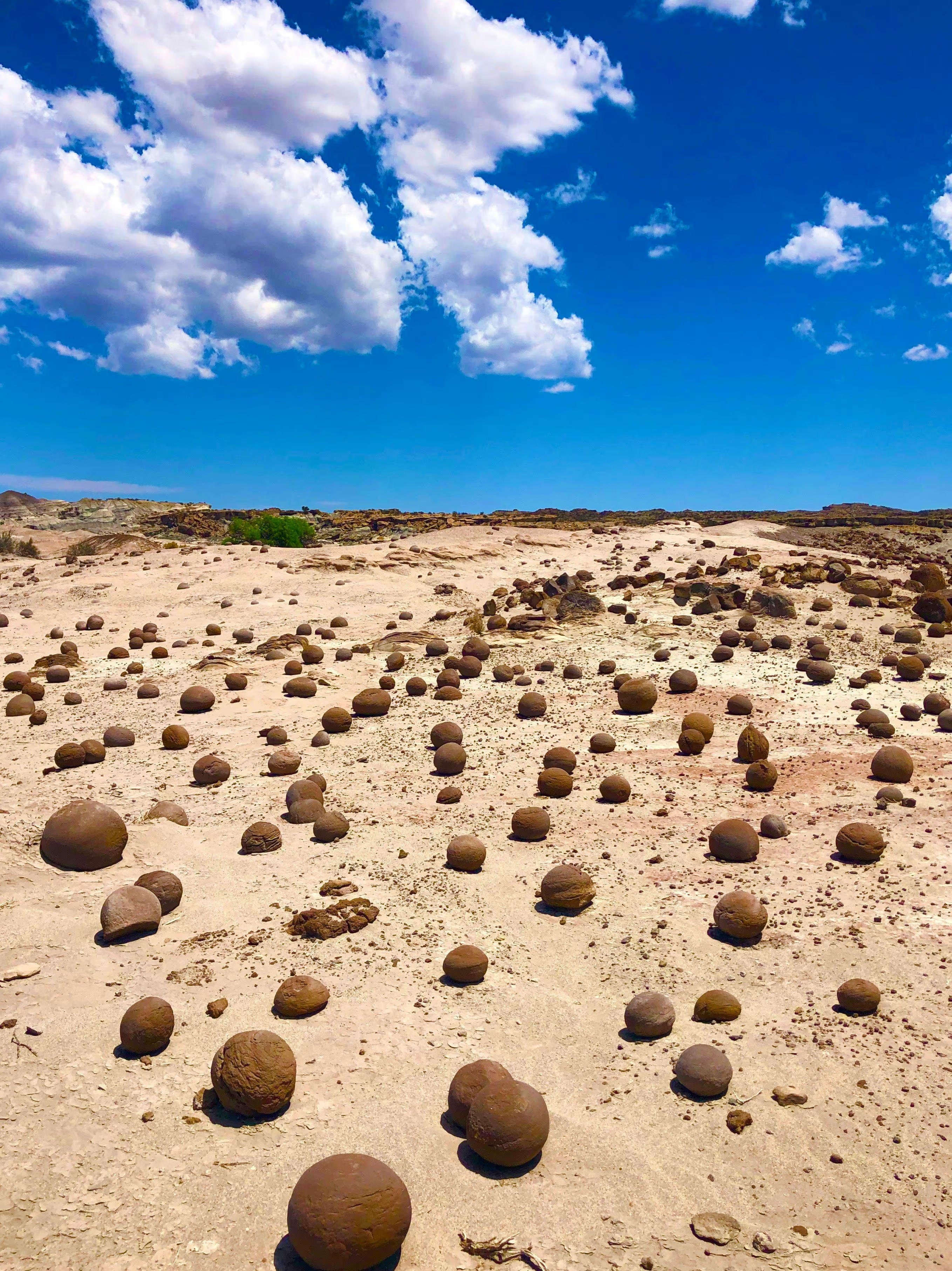
Pale ground. Weathered towers. Stones shaped into almost improbable spheres. Ischigualasto asks you to look across the desert, then much closer: this landscape holds a record of life long before the familiar outline of Argentina.
Ischigualasto occupies the northeastern corner of San Juan province, where pale badlands meet rust-coloured cliffs and an immense sky. Its familiar name, Valle de la Luna, describes the feeling of the scenery better than its history. This was once a landscape of water, vegetation and animals whose remains now help explain a much earlier world. The traditional circuit introduces both stories: the shapes made by erosion and the older life preserved beneath them. Talampaya, across the provincial boundary in La Rioja, shares its World Heritage designation but offers a different experience inside high red canyon walls.
01
What makes the visit distinctive
The pleasure is in changing scale. El Hongo and El Submarino are recognisable silhouettes; Cancha de Bochas draws the eye towards individual stones. Between the named formations, look at the exposed layers and the colours running through the ground. The scientific importance of the park gives those views another dimension. Take the guide's explanations seriously, especially if your first interest is photography: understanding the landscape makes the stops more memorable.
02
How much time to give it
Our recommendation is one full day with an overnight nearby, even though the traditional circuit itself takes only part of that day. Add a second Ischigualasto day if a guided walk or night visit is central to your interests. For a combined Ischigualasto–Talampaya journey, two dedicated park days and three regional nights make a useful starting plan. Travellers with only one day should choose the park whose style of visit appeals most.
03
Where it belongs in the journey
San Agustín del Valle Fértil is a useful base on the San Juan side; Villa Unión makes sense to consider when continuing through La Rioja. Choose the sequence from your arrival and onward direction. Staying on each side can reduce backtracking, while one base removes a hotel move. The better choice depends on whether you value a shorter morning approach or the ease of returning to the same room.
Ischigualasto · Rounded stone concretions
At ground level
Small stones. A vast desert.
At Cancha de Bochas, rounded concretions sit among the broken surface of the desert. Their almost deliberate arrangement is part of the surprise. Give the stop time beyond the first wide photograph: light along an edge, a shadow beneath a sphere and the rough ground around it each reveal a different scale of the same place.
01
Shapes with a history
These are geological forms, not objects placed for a game. Ask the guide how concretions develop and how erosion brings them into view.
02
A landscape to leave intact
Stay within the viewing area and leave every stone in place. The setting matters as much as the individual shapes.
San Juan · Eroded desert country
More than a silhouette
Look beyond the named shapes.
The Triassic record here and at Talampaya reaches back roughly 250 to 200 million years. Early dinosaurs shared those environments with many other animals, including relatives of the mammal line. That breadth matters: the parks preserve evidence of changing ecosystems, not simply a collection of impressive bones.
01
The William Sill site museum
The museum connects the drive with palaeontological work. Fossils and their setting make the difference between recognising a formation and understanding what it contains.
02
Two different clocks
Sediments record ancient environments. Weathering gives the exposed rock its present form. Keep those timescales separate when looking at a tower or a canyon wall.
San Juan · Low light through a window
The wider San Juan journey
Give the desert another morning.
An overnight in the wider desert country gives the visit a less hurried frame. Arrive, settle in and leave the main circuit for a rested morning. After the park, there is time to talk through what you saw over dinner, rather than measuring the remaining light against a long return to San Juan city.
01
For a landscape-focused stay
A second day can hold a different guided activity. Choose a walk or full-moon visit for the change in perspective, with its own confirmed arrangements.
02
For an onward journey
Continue towards Talampaya the next day, or return through Valle Fértil. Build the accommodation sequence around the route you are actually taking.
These suggestions help shape a first visit. Circuit availability and operating details should be checked with the park for your dates.
01
The traditional circuit
Understand the shape of the day.
The main daytime circuit is a managed vehicle route of about forty kilometres with designated stops. The park currently describes a visit of around three to three and a half hours. Its published arrangements use arrival order for this circuit; reservations for alternative activities work separately. Check the day's entry window before leaving your base, especially when heat affects departures.
Choose an organised excursion if you want the approach and vehicle arrangements handled together. If using a rental car, confirm how your vehicle joins the managed visit.
Allow time before and after the circuit for arrival, food and the museum experience. A late departure from a distant city leaves very little flexibility.
02
What deserves attention
Follow more than the famous outlines.
El Hongo, El Submarino and Cancha de Bochas give the visit a set of memorable landmarks. Their names make an easy way into the geology, but the ground between them deserves attention too. Look for changes in colour and texture rather than waiting only for the next named stop. A useful question for the guide is what the rock reveals about the environment in which it formed.
At the site museum, focus on how a fossil is recognised and studied in context. That is a different experience from looking at a finished skeleton in a city museum.
For photographs, vary a broad view with a closer detail from the authorised stop. An entire day of similar wide frames can miss much of what makes this park distinctive.
03
Beyond the first circuit
Choose another perspective.
Cerro Morado is the option to investigate if you want an ascent and a wider view over the park. Its summit reaches about 1,800 metres, and the walk requires advance arrangements. Río Salado and the mountain-bike circuit offer other ways to extend a stay. Match the activity to your interest and fitness, rather than treating every alternative as an interchangeable extra.
A full-moon circuit changes the light and atmosphere. Use the full-moon reservation information to confirm the operating dates and reserve it separately; a daytime entry does not automatically include a night visit.
For a guided walk, ask about ascent, surface, duration and the return. Reserve an extra morning for it instead of squeezing it between two long road journeys.
04
Season and comfort
Give the desert conditions a say.
In hot weather, the best plan leaves room for the park to alter departures and for you to spend time out of the sun between activities. Cooler conditions can make standing at the stops more comfortable, but an early start or an evening visit may need warm layers. The visit involves repeated transitions between a vehicle and exposed ground, rather than one continuous walk.
Carry drinking water, sun protection and footwear suited to uneven viewing areas. Keep a layer accessible instead of buried in luggage.
For mobility needs, ask about each stop, vehicle entry and the museum. The phrase vehicle circuit does not tell you whether every part of the visit will work for your party.
05
Valle Fértil or Villa Unión
Choose which morning to simplify.
A Valle Fértil base works naturally with a journey from San Juan and gives Ischigualasto the focus. Villa Unión is worth comparing if Talampaya and more of La Rioja come next. Neither choice removes the need to reach the park entrance. Look at the actual accommodation address, the following day's road and where you will eat after returning.
For two park days from one room, compare the complete drives to both entrances before booking. Convenience should describe the whole stay.
For a moving itinerary, sleep on the San Juan side before Ischigualasto and consider continuing towards the next day's Talampaya base afterwards, with enough daylight for the transfer.
06
Pairing the parks
Make the contrast part of the trip.
Ischigualasto rewards attention to open badlands, individual forms and scientific interpretation. Talampaya puts you inside a more enclosing landscape, with sandstone walls, rock art and different guided routes. Seeing both is worthwhile because the experiences complement each other. It is also perfectly reasonable to choose one when the available time would otherwise turn both visits into a race.
With two days, give each park its own main activity and return. With a third full day, add the alternative circuit that interests you most.
Keep bookings and entrance details separate. One World Heritage property still contains two parks with different administrations and visitor arrangements.
Before you go
Check the details for your dates.
Official visitor information and background for the places described here.
Across the provincial boundary, Talampaya changes the scale again. Set aside another day for its canyon and choose the circuit before arranging the journey.