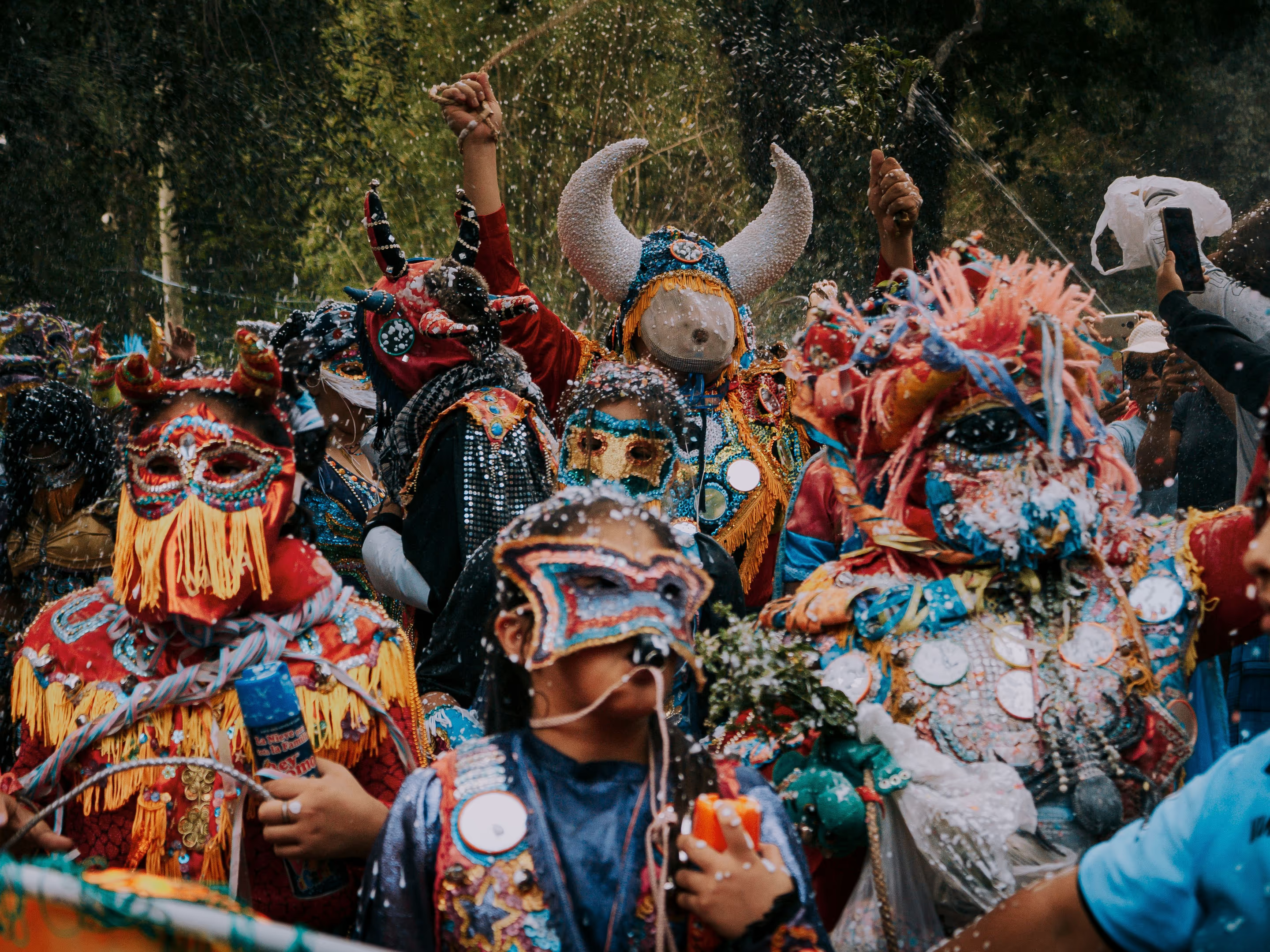
Jujuy, community and celebration
Carnival in Argentina: begin with the Quebrada
Understand the local context, choose a useful base and plan around official dates for a thoughtful Carnival visit in the Quebrada de Humahuaca.
Choose one place, learn what is being celebrated and give the occasion time. Carnival is more rewarding when the visit follows the community's rhythm.
Carnival in Argentina is not one celebration repeated in different towns. The setting, music, participants and relationship between a public event and a community gathering change from place to place. In Jujuy's Quebrada de Humahuaca, that difference is the reason to go slowly.
A useful visit begins with a particular town and the programme published for the year you will travel. Learn enough about the celebration to understand what you are seeing, then leave room to listen and follow local guidance. Trying to collect several famous moments in a single day can turn a visit into a sequence of arrivals after the thing you hoped to experience has moved on.
This is a Quebrada-led way to plan Carnival: choose the experience, find the current dates, secure a sensible base and approach the festivities as a guest. The reward is not only colour in a photograph. It is the chance to notice how a place gathers, remembers and celebrates.
Start with the Quebrada, not a generic festival image
The Quebrada de Humahuaca is a lived cultural landscape, not a backdrop assembled for visitors. UNESCO recognizes its long role as a route of movement and cultural exchange. Its towns, agricultural spaces and surrounding hills belong to that continuing history.
Carnival adds a particularly visible season of gathering to the place. National and provincial tourism sources describe comparsas, music, costumes and ceremonies associated with the beginning and ending of the celebration. Those broad descriptions are an introduction, not a complete explanation of every community's practice.
Understand what a comparsa represents
A comparsa is a group that takes part in the celebration with its own identity. Jujuy's guide-training material describes groups with their own song, leadership and flag, while emphasizing that customs differ between them.
That distinction matters to a visitor. Two groups in neighbouring places may share recognisable elements without following an identical sequence. Ask about the group and occasion in front of you instead of treating every costume or gathering as interchangeable.
If you join a guided visit, choose someone able to explain that local context and the expectations of visitors. A guide's value is not merely getting you to a crowded viewpoint; it can be helping you understand where you are welcome and what the moment means.
The devil figure needs its local context
Official descriptions of Quebrada Carnival refer to the desentierro, or unearthing, of the carnival devil and its later burial. The provincial guide material explains that the carnival figure should not simply be read as the devil of Catholic doctrine.
Avoid reducing the ceremony to a literal translation or a theatrical trick. The celebration brings together Andean and Catholic influences, with meanings shaped by local practice. Listening to an informed explanation is more useful than attaching a dramatic interpretation of your own.
You do not need to become an expert before attending. A little preparation helps you ask better questions and recognize that the most visible element may not be the whole event.
Separate the holiday calendar from the local programme
Argentina's national holiday law lists Carnival Monday and Tuesday. That does not mean every town's celebration begins on Monday, ends on Tuesday or follows the same public timetable.
Jujuy’s published 2026 programme, for example, included preparatory Thursdays, the central Carnival period and later events identified as Carnaval Chico, de Flores and de Remache. It demonstrates the breadth of the season; it does not establish the dates of a future edition.
Use the correct year
Check the year on every programme before using it to book travel. Search results can place an older schedule near a current tourism page, and an attractive poster may circulate long after the event it advertised.
For a 2027 trip, use the official national calendar and Jujuy’s official tourism site for a future programme when published; that homepage is not a verified 2027 programme. Treat travel plans as provisional until the relevant dates and local events are published. A date calculated from Easter cannot tell you which celebration a town or comparsa will organize, where it will happen or how visitors can attend.
The holiday-planning guide explains the categories and where to check. Use it alongside the municipality or event organizer for the specific celebration you want to attend.
Read the event name as well as the date
A concert, a public parade, a comparsa gathering and a ceremony at a mojón are different occasions. A ticket for one does not necessarily include another, and the atmosphere may differ substantially.
The published programme should identify the place and activity. If it is unclear, ask the tourism office or organizer what visitors can expect, whether a ticket is required and how access works.
Do not assume that the largest advertised concert is the only meaningful way to experience Carnival. Equally, do not assume that a community gathering is a free public attraction simply because it takes place outdoors.
The preparatory Thursdays have their own place
Jujuy's published programmes distinguish gatherings such as Jueves de Compadres and Jueves de Comadres from the central Carnival period. These are occasions with their own participants and local arrangements, rather than simply extra days added for visitors.
If one of those gatherings interests you, look for the description of that specific event. Ask whether the activity is a public concert, a community meeting or another format, and confirm where visitors should go. The shared name does not mean every town presents an identical programme.
The same care applies to a later Carnaval Chico or Remache event. A date after the national holidays can still belong to the local Carnival season, but only the current programme can tell you what is planned. This can offer a different way to shape a trip for someone whose dates do not fit the central weekend.
Do not treat the sequence as a schedule that every group must obey. The point of checking locally is to understand the particular celebration, including the variations that a broad regional summary cannot capture.
Keep confirmed and provisional plans distinct
You can choose a likely travel window and investigate accommodation before every local detail is announced. Read change terms carefully if the main event remains unconfirmed.
Keep a note of what is settled: flights, a room, a named event or a transfer. Put tentative ideas in a separate part of the plan so that enthusiasm does not quietly turn a possibility into a fixed appointment.
When the programme appears, revise the route around the experiences you most want. It is better to change the sequence before paying for additional transport than to spend the trip trying to make incompatible bookings fit.
Choose one useful base
The Quebrada's towns offer different settings and practical arrangements. Choose where you will sleep by the events you want to attend, the transport available and the kind of rest you need afterwards.
A room in the town hosting your main event can reduce the dependence on a late return journey. A quieter property outside the centre may offer a different evening but require a confirmed transfer. Neither is automatically better; compare the actual address with the programme.
Purmamarca
Purmamarca gives the ordinary days around Carnival a compact plaza-and-market setting. Time around the square and its craft stalls offers a village-based interest apart from a gathering, while Paseo de los Colorados is a separate walk through the coloured landscape behind the hills.
Choose those as two different parts of the stay: a town morning does not carry the same walking commitment as Colorados. Neither identifies a festival venue or establishes access to a future event. Check the announced location and the accommodation’s position when the relevant programme exists.
If you are considering an excursion towards Salinas Grandes, plan it on its own terms and on a separate suitable day. A late Carnival evening and an early higher-altitude outing may be an uncomfortable combination.
Tilcara
Tilcara offers town time alongside a distinct archaeological visit. Pucará belongs to the university’s visitor setting: use the University of Buenos Aires visitor information for that cultural outing’s current arrangements, rather than treating it as part of a Carnival programme.
A day at Pucará asks for time to look at the archaeological landscape and interpretation; an evening gathering follows a different purpose and timetable. Keeping the two separate gives the stay substance even when the event occupies only part of your visit.
Choose accommodation for the rest you need between them, asking about the actual sound and activity around the property. This comparison concerns ordinary days in Tilcara, not an unverified advantage in access to a comparsa or a future celebration.
Humahuaca
Humahuaca offers a historic town-centre base: the plaza, Cabildo setting and streets leading towards the independence monument give an ordinary town day its own subject. Humahuaca is a town within the Quebrada, not simply another name for the whole valley.
Hornocal remains a separate excursion with its own approach, altitude and current access considerations. It is neither a Carnival venue established by this guide nor an assumed same-day addition between events. Choose a suitable separate opportunity if the viewpoint is part of your interest.
The town-centre day and the mountain excursion therefore make different demands on the stay. Use the published local programme to place the celebration around them, leaving enough room for meals, rest and the return from any outing.

Arrange transport before the evening
The important transport question is often how you will return, rather than how you will arrive. Check the service for the actual date and the location of the event.
A public bus, an arranged transfer and a guided outing offer different degrees of flexibility. Compare their departure points, return arrangements and what happens if the event runs differently from the published plan.
Arriving from a regional gateway
If you arrive through Jujuy, organize the connection to your chosen Quebrada base rather than assuming an immediate service from the airport to every village.
If the wider trip begins in Salta, treat the journey north as a real transfer day. Leave space for arrival, the road journey and check-in before making the first important event depend on a precise arrival.
The getting-around guide can help compare modes, while the destination pages keep the towns and route choices distinct. Use the actual operator information for times and availability.
If you book a guided visit
Ask what the guiding adds beyond transport. A useful proposal identifies the occasion, explains how visitors will attend and leaves enough time for the event itself. Check the guide's language and whether the group will receive context before arriving.
Read the itinerary for the number of towns and stops. Several names can look like good value while leaving little time in any one place. Ask which gathering is the main purpose and what happens if its timing changes.
Confirm whether admission, meals and return transport are included. If a visit involves a community-hosted activity, ask how the arrangement has been made and what expectations apply to guests. A clearly explained visit helps you arrive with appropriate curiosity and a realistic sense of your role.
A rental car needs a parking and return plan
Driving can make some parts of a regional trip easier, but a car does not remove the need to understand event access. Ask where you can park and how you will reach the gathering from there.
If the evening involves drinking, arrange a driver or another return method in advance. Keep the plan clear enough that nobody discovers at the end of the event that each person assumed someone else had arranged the journey.
Check current official road information before longer excursions. A programme confirms an event, not the condition of every road you might use to reach it.
Confirm the meeting point
For an arranged transfer, agree a specific pickup location and how changes will be communicated. A broad instruction such as “near the square” may be unhelpful when several streets are busy.
Keep the driver's or organizer's contact available, and ask what waiting time or return window the booking includes. If the group may split, explain that before agreeing on one vehicle.
A little clarity gives you more freedom during the event. You can pay attention to what is happening rather than repeatedly trying to solve the journey home.
Attend as a guest
A public celebration can be welcoming without making every person, object or private space available to a visitor. Let the people responsible for the occasion set its boundaries.
Watch how others approach the gathering and ask when unsure. A simple question about where to stand, whether to join or when to take a photograph can prevent an awkward assumption.
Give the event room to happen
Keep paths and working areas clear. Avoid placing yourself where participants need to move simply because the camera angle is attractive.
If an organizer asks visitors to wait, move or stop photographing, follow the request. A useful view is one that does not interfere with the people creating the occasion.
This also applies to a guided group. Choose a place where the group can listen without blocking a doorway or surrounding someone who has not agreed to become the centre of attention.
Participation is an invitation, not a test
You do not have to imitate every action or accept every offer to show interest. A respectful refusal can be as appropriate as joining in.
Ask about what is being offered and what participation involves. If you prefer to observe, do so without treating observation as permission to move into any space you want.
Avoid framing the visit as a challenge to prove how adventurous you are. The event belongs to the people who sustain it throughout the year; your experience is one small part of a larger occasion.
Photograph people with care
A broad scene and a close portrait make different demands on the people pictured. Ask before a close photograph where practical, particularly when the person is not actively posing for visitors.
Give people the chance to decline. Do not keep directing them into a position after they have returned to what they were doing, and avoid interrupting a ceremony to improve a composition.
A smaller number of considered photographs can tell the story better than a large set made while looking past the people involved. Leave some moments unrecorded so you can experience them directly.
Listen for more than spectacle
Carnival's visual elements are immediate, but music and voices can offer a different way into the occasion. Official Jujuy sources describe coplas and instruments associated with the region, while emphasizing the variation between places.
You may not understand every word or recognize every instrument. That is a reason to listen and ask at an appropriate moment, rather than to treat the sound as background for a video.
Notice the group rather than only the costume
Watch how people respond to one another, how a song gathers participants or how a group signals movement. These details can reveal the collective character of the celebration.
Avoid assigning a single meaning to a costume based on its colour or appearance. If you want to know more, ask the participant, organizer or an informed local guide when the moment allows.
The most useful explanation may be specific: this group, this gathering, this year's preparation. That can be more illuminating than a sweeping account of what all Carnival in northern Argentina supposedly means.
Make room for conversation
A meal or a quiet interval can be a better time for questions than the centre of a busy event. Ask open questions and allow people to decide how much they want to share.
Do not expect every resident to become a guide, or treat someone else's personal account as a universal rule. Different generations, families and groups can describe the same celebration from different perspectives.
Those differences are part of the interest. A visit becomes richer when it leaves room for more than one voice.

Let meals and rest support the visit
It is easy to plan the headline event and forget the ordinary needs around it. Decide where you will eat, how you will get back and when you can rest before the next journey.
A celebration-focused trip should still be comfortable enough to enjoy. Leave gaps between major commitments, especially after travel or a late evening.
Choose a meal you can enjoy
Look at the actual menu and the time available. A long shared lunch can be part of the trip; a simpler meal may fit better before a gathering with a clear start.
The food feature on Salta and Jujuy introduces regional dishes and useful ordering questions. Treat meals as an opportunity to notice ingredients and preparation, rather than as another list to complete.
Ask about dietary requirements directly. A familiar dish name does not establish how a particular kitchen prepares it, and a busy event is easier to navigate when important questions have been settled early.
Plan the next morning honestly
A route that looks efficient on paper can be tiring when it follows a late celebration. Keep the following morning lighter where possible and avoid making every day begin with a long drive.
If a fixed excursion is important, give it a separate place in the plan. A restful morning does not mean the trip lacks ambition; it can make the next experience more enjoyable.
For a group, agree the next day's expectations before the evening. People can then choose how long to stay without discovering that others expected an early departure.
Account for altitude and the route
The Quebrada's towns and nearby excursions sit at different elevations. Use the destination guides and the altitude-and-health page to understand the planning questions, and seek personal medical advice where needed.
Do not treat a higher excursion as interchangeable with time in the town. The journey towards Salinas Grandes needs its own transport, access and altitude considerations.
Keep the first part of the stay manageable and pay attention to how you feel. A cultural visit is more rewarding when the itinerary leaves room to respond to your own needs.
Build a wider Northwest trip around the celebration
Carnival can be the anchor for a journey through Salta, Jujuy and the Northwest, but it should not force every other place into a rushed circuit.
Choose whether the rest of the trip will stay close to the Quebrada or include another region. Add the actual transfer days before deciding how many bases fit.
Give Salta its own time
Salta can offer a city stay before or after the Quebrada. Use it for the interests you want there rather than simply as a night between transport connections.
A city meal, a museum or a quieter afternoon can provide contrast after several days built around gatherings. The change of pace can help you absorb what you have seen.
Confirm the onward transport and accommodation before adding a tightly timed activity to the transfer day. A clear arrival leaves the first evening easier to enjoy.
Choose another valley deliberately
Cachi and Cafayate belong to a wider Salta itinerary with their own road planning and overnight decisions. They should not be treated as nearby stops to insert casually between Quebrada events.
If wine, food or the Calchaquí valleys are central interests, give them a separate block of time. Compare the route, the current road information and the transport arrangement before committing.
A focused trip to fewer places can leave a clearer impression than a larger circuit spent mostly transferring. Choose the additional region because you want to experience it, not because the map makes it appear to complete the Northwest.

Know which Carnival you are choosing
Elsewhere in Argentina, the form of Carnival can be quite different. The national tourism office describes the staged parade tradition of Gualeguaychú alongside the Quebrada's celebrations. One should not be used as a template for the other.
A seated or ticketed parade, a large concert and a community-based gathering ask different things of the visitor. Compare the experience and the current programme before deciding where to travel.
Avoid a single national ranking
There is little value in declaring one Carnival the best without saying what you want from it. Elaborate choreography, local music, a particular town and a chance to learn about community practice are different priorities.
A traveller who wants a clear ticket, seat and performance may prefer a different event from someone hoping to spend several days in the Quebrada. Both can make a good choice when the expectations are accurate.
Do not judge a smaller gathering by the scale of a major staged event. Its significance may lie in relationships and continuity that are not immediately visible to a visitor.
Use local information for the final decision
Once you have chosen the region, consult the current provincial or municipal programme and the named organizer. Check the date, place, ticketing and transport together.
If information is still provisional, keep the affected bookings adjustable. An earlier year's photographs and programme can explain the atmosphere, but they should not become evidence that the same event will occur in the same way.
Choose the kind of contact you want
Before choosing an excursion, describe the visit you would find meaningful. You might want an introduction to the history and the names used in a programme, time listening to music, or a public event that can be reached from your chosen town. Those are clearer requests than asking a guide to show you the “most authentic” Carnival.
Ask how the proposed visit connects with the people organizing the occasion. The answer should make the arrangement understandable: where the group will meet, which parts are open to visitors and what happens if a gathering changes. An itinerary that treats a private invitation as a guaranteed attraction needs clarification before you book it.
For a group with different interests, agree on a meeting point and a reasonable time to regroup. Some people may want to stay with a musical performance while others prefer a quieter afternoon. You do not have to move as a single unit through every moment, provided the return arrangements work for everyone.
Afterwards, keep the names of the town, group and event with your photographs. A caption identifying the occasion is more respectful and more interesting than labelling every image simply “Carnival in Argentina.” It also helps preserve the distinctions you travelled to understand.
A visit with enough room to understand
Before booking, make the essential choices clear:
- Choose the place and occasion. Begin with one town and the event you actually want to attend.
- Check the current year. Use the official holiday calendar and the local programme separately.
- Book a useful base. Compare the accommodation address, rest and return transport.
- Leave space around the event. Meals, travel and recovery belong in the itinerary.
- Follow local guidance. Ask about participation and photographs, and let the celebration happen on its own terms.
The best Carnival visit does not depend on seeing everything. It comes from being present for something you have chosen thoughtfully, with enough time to notice the people and the place around it.


