A town of narrow streets and remembered histories. Above it, a ridge folded into extraordinary colour. Give Humahuaca time at ground level, then decide whether the higher road belongs in your journey.
Humahuaca offers a reason to continue north through the Quebrada: its streets, public buildings and Independence Monument tell a different story from the smaller villages farther south. Hornocal is reached on a separate climb into much higher country. Treat the town walk and mountain excursion as two decisions, especially when arrival, altitude or weather limits the day. Staying here can reduce repeated driving, but an overnight booking alone does not establish acclimatization. Humahuaca is roughly 3,000 m above sea level; Visit Argentina lists 3,012 m as its reference elevation. Treat the higher Hornocal outing separately from a night in town. See altitude and health when choosing the sequence of nights.
01
A town visit
Begin around the centre, look at the Cabildo and choose a comfortable route towards the Independence Monument. Its steps need more effort than a level stroll. Leave time for a meal and the streets beyond the main square.
02
A Hornocal outing
Confirm the current road, viewpoint access and transport arrangements locally. The outing rises well above town; how you feel after gaining elevation matters more than a preferred time for photography.
03
An overnight base
Consider a stay when the northern valley is a main interest. If most of your plans are around Purmamarca and Tilcara, compare a day visit with the additional packing and transport of changing hotels.
Humahuaca · A portrait from the town
Humahuaca at street level
Stay for the human scale.
The town is a place of homes, shops and daily routines as well as heritage. Start at the plaza and Cabildo setting, then walk the surrounding streets to read Humahuaca’s historic urban fabric. Adobe houses and narrow street corridors belong to the town's accumulated everyday history; the prominent independence monument is a later commemorative layer. A local guide can connect those different periods without presenting the whole town as one unchanged colonial scene.
01
Walk with attention
The Cabildo and Independence Monument belong to different moments in the town's development. Read the interpretation and allow time for the steps rather than treating the centre as one flat circuit.
02
Make room for conversation
Ask before photographing people closely or entering private spaces. Browse and eat without assigning every encounter a place on the itinerary. The town deserves attention beyond its landmarks.
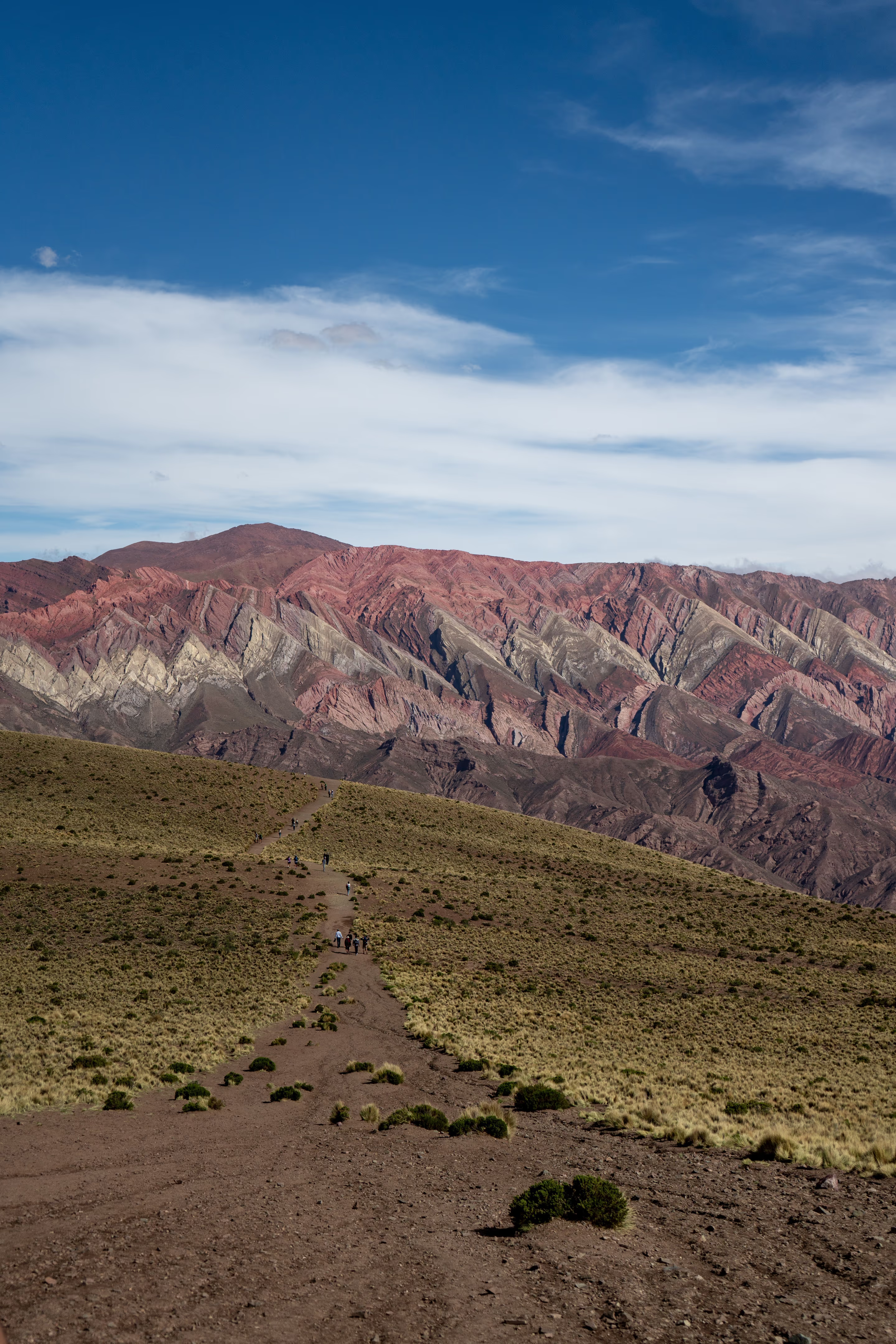
Hornocal · Ridges beneath low cloud
The higher road
Let the ridge fill the view.
Hornocal's folded colours are seen from a viewpoint reached by a mountain road beyond Humahuaca. The journey and elevation are part of the decision, not incidental details. Compare a locally arranged transfer with driving yourself, and check conditions before committing to a departure.
01
Ask about the complete outing
Confirm the vehicle, pickup, highest point, walking involved and return. A road distance does not describe the time or effort of the mountain section.
02
Keep the plan flexible
The ridge may disappear into cloud, and altitude symptoms are a reason to stop ascending. A photograph is never a reason to continue when you feel unwell.
Humahuaca surroundings · Vicuñas on the hillside
Beyond the town edge
Notice the wider country.
From the plaza and Cabildo setting, climb the broad steps to the Monumento a la Independencia, then pause to look back over Humahuaca and towards the Santa Bárbara tower. The Monumento a la Independencia and town visit complements the smaller streets below: the twentieth-century monument commemorates the independence struggle, while the surviving tower and surrounding adobe town show other layers of the settlement. Give the ascent and the view their own time instead of treating the monument as a quick photograph before a countryside drive.
01
Observe from a distance
Keep wildlife undisturbed and stay on permitted routes. The photograph records one sighting; it does not promise that the same animals will appear on your visit.
02
Choose a manageable radius
A shorter outing with time to stop can offer more than a long circuit. Confirm access and return arrangements before leaving the main valley.
Plan your visit
Plan the climb around the stay.
Time allowances are our editorial suggestions. Check access and transport for your dates.
01
How long
Keep a usable town morning.
One night can give an evening and morning around Humahuaca; two provide more flexibility for a higher outing. These are starting points, not a required itinerary. Look at arrival and departure times before counting how much of the town you will actually see. Avoid making both travel days long excursions.
02
Altitude
Treat Hornocal as another ascent.
The viewpoint is around 4,350 metres, substantially higher than Humahuaca. Build gradual ascent into the wider journey and seek medical advice before travel if relevant health conditions concern you. Do not go higher with altitude symptoms. If symptoms worsen, descend and seek medical assistance rather than waiting for the excursion to finish.
03
Transport
Compare the return, too.
Use the provincial catalogue's Hornocal community visitor information to understand the community entrance and viewpoint that form this outing's endpoint. Confirm current entry arrangements locally rather than treating the catalogue's published hours or tariff as current. Ask exactly where a service collects and returns you, and whether the quoted visit includes local entry. Check current road conditions if driving. A shared departure may need time to fill or follow a fixed schedule; a private transfer should still have a clear plan for the entire outing.
04
In the centre
Allow for steps and uneven surfaces.
The central streets and the monument approach do not offer identical walking conditions. Choose what suits your mobility, pause when needed and ask locally about access to individual buildings. Start with a comfortable town circuit rather than assuming that reaching the main square means every viewpoint is equally accessible.
05
Where to stay
Choose your evening address.
A room near the centre makes it easier to step out for a meal. Check the actual approach, parking and heating arrangements for the property, particularly when nights are cold. A quieter address outside the core may suit you, provided you have planned dinner and the return journey as carefully as the room.
06
Onward journey
Keep the valley and Puna distinct.
Tilcara and Purmamarca continue the valley journey south; Salinas Grandes requires a different westward climb. Avoid joining every famous view into a single rushed day. Compare the road hours with the time you want at each place, and retain a lower, gentler alternative if the high-country plan no longer suits you.
Before you go
Check the details for your dates.
Official visitor information and background for the places described here.
Salinas Grandes asks for a separate route and its own altitude planning. Compare the journey from Purmamarca before adding the salt flats to your stay.