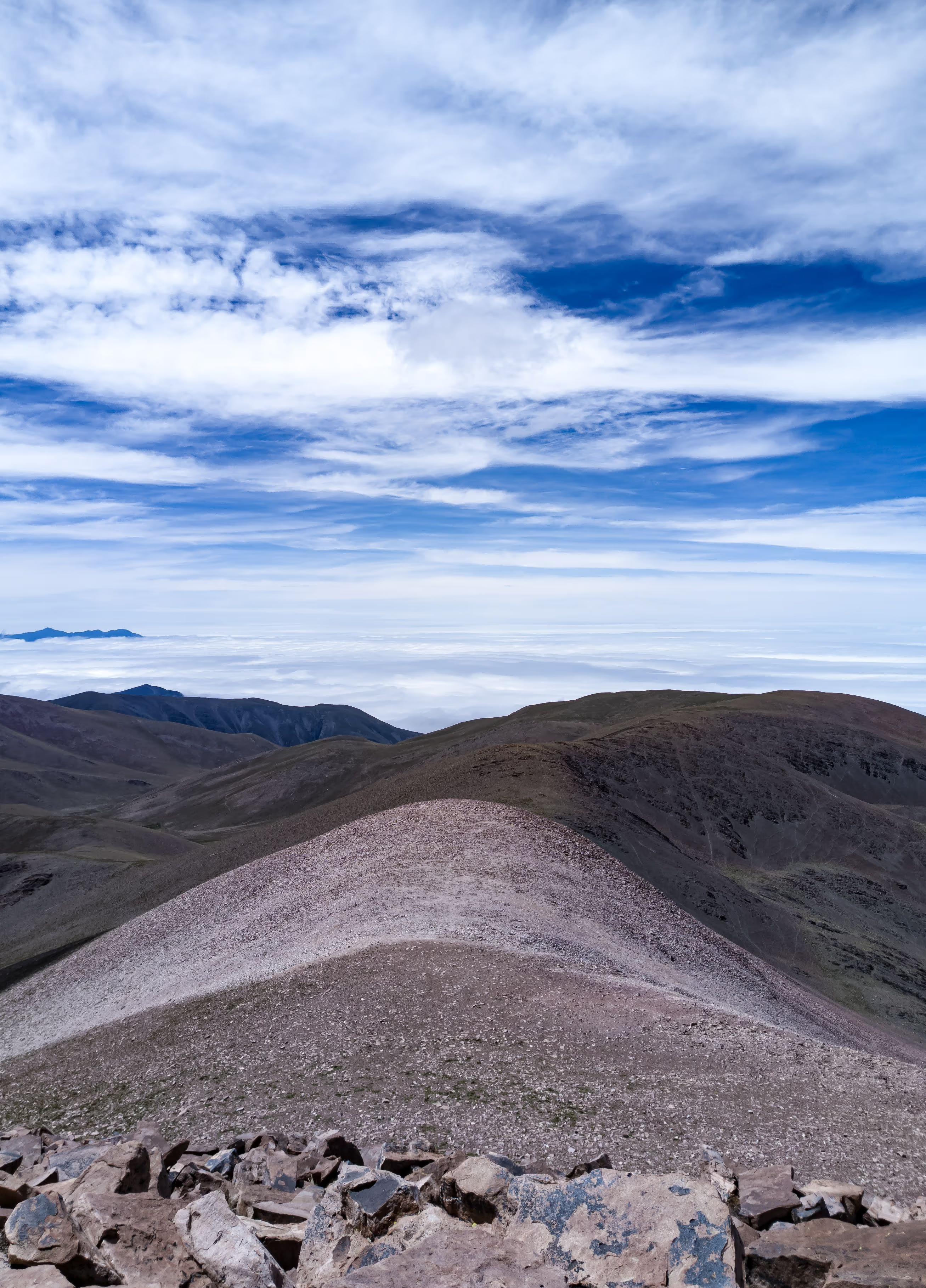
Mountain ridges beneath dramatic cloud in Jujuy Province.
Prepare for the route
Give the heights time.
High passes and remote landscapes need more than a spare day. Plan where you sleep, know when to change course and arrange health advice around your own itinerary.
Argentina’s distances are easy to see on a map; changes in elevation need a separate look. A Northwest journey can move from a city base into high valleys and across much higher passes within one day. The place where you spend the night matters, as does the speed at which you reach it. Health preparation also extends beyond altitude: a humid forest visit, a long flight and a remote outdoor activity ask different questions. Take the actual itinerary to a travel-health clinician, especially if you have an existing condition or previous difficulty at altitude. Specific advice is more useful than a generic list for an entire country.
01
Map the nights
Write down the sleeping places in order and obtain their elevations from a reliable route source. Add the high points of day trips so the full pattern is visible.
02
Keep the plan adaptable
Choose arrangements that allow a shorter outing, a lower overnight stop or a rest day if needed. Flexibility is useful only when you know how you would use it.
03
Share the relevant detail
Tell the clinician about your health history, medicines, planned activities and remoteness. Tell an operator the information needed to support the activity safely and appropriately.
A broad mountain landscape in Salta Province.
01 / Build the ascent
Plan where you sleep.
A gradual rise in sleeping altitude is a central part of reducing altitude risk. Fitness does not protect against altitude illness, and having felt well on a previous trip is not a guarantee this time. A day excursion that returns lower can be less demanding than sleeping high, but it is not risk-free. In the Northwest, separate the question of where to stay from the question of which high viewpoint to visit. Salta, the Quebrada’s towns and the Puna are not interchangeable bases. Give your clinician or experienced operator the sequence of nights and proposed excursions rather than only the regional names. For a route combining Salta, Purmamarca and a high-country excursion, draw each move separately. A day that looks like a short addition to a village stay may be the biggest elevation change of the trip. Adjust the sequence before treating that excursion as an automatic first-morning choice.
01
Show the whole sequence
Include arrival from low altitude, the first overnight stop and the highest excursion. Ask whether the rate of ascent needs changing before the accommodation is fixed.
02
Keep the first days gentle
Allow time to adjust and avoid strenuous activity and alcohol during the initial period at altitude. Do not use a packed activity schedule to test how well you are coping.
03
Discuss prevention properly
Ask a clinician whether preventive medicine is appropriate for your circumstances. Medication does not replace a sensible ascent plan; do not improvise a prescription from another traveller’s experience.
04
Bariloche · about 770 m
The municipal tourism guide gives this reference for the city; mountain outings rise above the lakeshore base.
05
Cafayate · about 1,683 m
Visit Argentina’s town reference is distinct from the higher parts of a Calchaquí Valleys route.
06
Purmamarca · about 2,324 m
Visit Argentina gives the village elevation; the road towards Salinas Grandes climbs higher.
07
Tilcara · about 2,465 m
Visit Argentina’s average elevation is a reference for the base, not every walking route.
08
Humahuaca · about 3,000 m
Visit Argentina lists 3,012 m. Plan the separate Hornocal ascent on its own terms.
09
Salinas Grandes · roughly 3,400–3,450 m
Visit Argentina gives 3,400 m in its introduction and 3,450 m as an average; Jujuy’s tourism manual also gives 3,450 m. These are approximate descriptions of the salt flats, not identical precise measurements.
Rocky highland terrain under cloud in Jujuy Province.
02 / Recognise a change
Do not climb through it.
Altitude illness can affect unacclimatised travellers around 2,500 metres and sometimes lower; there is no single elevation below which symptoms can be dismissed. After ascent, headache, nausea, unusual tiredness or loss of appetite deserve attention. Do not ascend farther while symptoms persist. If they worsen while you remain at the same altitude, descend. Confusion, loss of coordination or breathlessness at rest are emergency warning signs: arrange immediate descent and urgent medical help, and do not leave the person alone. A timetable, prepaid excursion or reassuring watch reading should not delay action. If a group has booked a private vehicle, discuss in advance how an early return would work for one unwell participant. With a shared departure, ask the operator about its procedure. Resolve the practical question before the group is far from the place it would need to return.
01
Speak up early
Tell your companions and guide when you feel unwell. The group needs that information before choosing the next leg, particularly when a vehicle will travel higher or farther from help.
02
Make the lower option real
Before a high excursion, establish the route back down, available transport and who will arrange assistance. A plan to descend is useful only if the group knows how to act on it.
03
Let the booking change
Treat an unwell traveller’s needs as the priority. Keep a contact for accommodation and onward transport so someone else can handle the practical changes while help is arranged.
A travel-health consultation should cover the particular regions and activities, not just the word Argentina. Review routine vaccines and any itinerary-specific recommendations, including whether yellow-fever advice applies to the areas you will visit. Discuss insect protection, food and water precautions, regular medicines and any condition that could affect travel. Use current destination guidance for alerts close to departure. A journey confined to Buenos Aires is different from one that adds the subtropical Northeast or an extended remote trip. Give the clinician enough time to plan recommended measures, and bring the route back for review if it changes substantially. If you add Iguazú after a Northwest itinerary has already been reviewed, tell the clinician about the change rather than assuming the earlier advice covers it. A revised list of places and dates makes the follow-up clear and helps focus on what the new leg changes.
01
Take the itinerary
Include dates, overnight places, outdoor activities and travel beyond Argentina. A list of booked bases is more useful than a country-level summary.
02
Keep treatment consistent
Ask how to manage regular medicines, storage and supplies during the journey. Keep essential treatment and supporting documentation accessible rather than in checked baggage alone.
03
Plan access to care
Identify where you would seek help from each main base and how the insurer’s assistance service works. Remote travel may require a different response from a city appointment. Under Resolution 1066/2026, effective from 12 August 2026, foreign patients without permanent residence must show health insurance or pay in advance for routine care in establishments administered by the national state. Emergency assessment, stabilisation and immediate treatment are excepted. Care after the emergency has passed can be billed. Do not generalise this procedure to every provincial, municipal or private facility; ask the provider and insurer how your care will be arranged. Use the Health Ministry’s yellow-fever information and outdoor-travel recommendations to prepare questions for your clinician, rather than treating a destination list as an individual vaccination prescription.
Use these questions to prepare the route and the conversations around it. Individual medical decisions belong with a qualified clinician who knows your circumstances.
01
Route
Draw the elevation sequence
Put the overnight locations, high day trips and travel days on one page. Ask for the elevations of the actual places, not a provincial average. Highlight any day when you arrive low and move much higher before sleeping.
Record where the group will sleep each night.
Add the highest points on planned excursions.
Show the sequence to the clinician or qualified operator.
Keep a lower alternative within the transport plan.
02
Personal advice
Bring the relevant history
Tell the clinician about previous altitude problems, ongoing conditions, pregnancy if relevant, medicines and the activities you intend to attempt. The aim is advice tailored to you, including whether the proposed route should change.
Take a current medicine list.
Explain the most demanding and remote activities.
Ask what symptoms should trigger your agreed response.
Clarify any individual limits before booking an excursion.
03
Operators
Ask about the return plan
Choose an operator who can explain the route and its response to an unwell participant. Ask how the group communicates, what happens if the vehicle needs to return early and how a person reaches appropriate care.
Confirm the high points and sleeping places.
Ask who makes the decision to turn back.
Understand the communication and assistance arrangements.
Avoid relying on mobile reception as the only contact method.
04
Insurance
Match cover to the activity
Read the policy’s conditions for existing health problems, altitude, hiking, specialist activities and evacuation. Confirm any uncertain point with the insurer before travel. A general holiday policy description is not enough to establish cover for a particular remote outing.
Declare the information the insurer requires.
Check altitude and activity restrictions explicitly.
Save the assistance number and policy details offline.
Understand how to seek urgent help and report a claim.
05
Daily preparation
Keep the essentials with you
Pack for the conditions and the time away from the base. Carry drinking water, suitable food, sun protection and layers, while remembering that equipment cannot prevent altitude illness. Keep the day bag manageable enough to use throughout the outing.
Make regular medicines and essential information accessible.
Know where the group can pause or shorten the route.
Let companions know promptly if you feel unwell.
Do not treat a local drink or remedy as an ascent plan.
06
Assistance
Know who to contact
Keep local medical contacts and the insurer’s assistance service with the trip file. In Buenos Aires, SAME medical assistance is reached on 107; 911 is the general emergency number. For remote journeys, obtain the relevant local response and rescue contacts before leaving the base.
Give the precise location and nature of the problem.
Follow emergency-service instructions.
Keep an unwell person accompanied.
Let another traveller manage bookings while help is arranged.
Useful visitor information
Before you book.
These sources explain general risks and current destination guidance. A travel-health clinician can tailor advice to your medical history, sleeping altitudes and planned activities.
Bands of colour in the mountain formations of Jujuy Province.
Give the landscape its time
A slower way higher.
The Northwest offers plenty to notice between the headline viewpoints: the colour of a slope, a village square and the changing light along a valley. Build a route with time to settle and permission to change. Reaching the next high place should follow how the journey is going, not dictate it.