From Buenos Aires to Uruguay
Colonia del Sacramento: a day across the river
Choose a worthwhile day trip, understand the international ferry process and leave time to enjoy Colonia's streets, river views and a relaxed meal.
The crossing gives the day its shape. A clear booking and a little preparation leave the hours ashore free for the town itself.
Colonia del Sacramento offers a particular kind of escape from Buenos Aires: a different shore, streets on a smaller scale and a day whose main pleasure can be walking without much urgency. It is a good choice when that is what you want. It is less convincing when the aim is merely to add another country to a short itinerary.
The ferry is part of the experience, but it also gives the day a framework. You have a terminal to reach, international formalities to complete and a return departure to respect. The most enjoyable plan accepts that framework early, then leaves the hours in Colonia open enough for a meal, a few interesting streets and time beside the river.
Start with three decisions: whether Colonia is the best use of the day, whether the actual ferry options leave enough time ashore, and whether your documents permit the outward and return journeys. Once those are clear, the rest can be pleasantly simple.
Decide what you want from the day
A first visit to Buenos Aires can absorb far more time than a hurried itinerary allows. Colonia is worth considering as a deliberate contrast, rather than as a compulsory excursion after a checklist of city sights.
Its historic quarter is the attraction most likely to justify the crossing. UNESCO recognizes the combination of Portuguese, Spanish and later influences in its buildings and street pattern. Founded by the Portuguese in 1680, the settlement developed through a contested colonial history. The interest is in the relationship between streets, modest buildings and the river, not just in finding one monument to photograph.
Choose Colonia for a change of scale
If you enjoy architectural details, a slow lunch and an afternoon with room to wander, a day across the Río de la Plata can fit naturally between busier city days. You do not need to attach an activity to every hour to make it worthwhile.
If your priority is a major museum collection, a performance or a particular Buenos Aires neighbourhood, keep the day for that interest. Travel time is not wasted when the journey is something you want; it feels different when it displaces the thing you came to see.
The same applies to a group. Agree whether the appeal is history, the ferry, a meal or simply a change of scene. A shared expectation prevents one person from planning a series of admissions while another imagines sitting beside the water.
Compare it with a day that stays in Argentina
Tigre and the Delta offers another way to make water central to a day away from the capital. Choose it for the delta setting and the particular outing you arrange, rather than as a substitute with an identical experience.
San Antonio de Areco belongs to a different kind of day again: town streets, craft traditions and, if booked separately, a rural visit. Comparing these options by interest is more useful than ranking them by how often they appear on day-trip lists.
For a short city stay, you may get more pleasure from an unhurried afternoon in San Telmo or a museum-focused day around Recoleta. Colonia becomes a stronger choice when you have already allowed room for the parts of Buenos Aires that matter most to you.
Book time ashore, not just a crossing
Look at the departures actually sold for your travel date. The outward sailing, the return sailing and the reporting requirements together determine how the day works. A headline crossing duration cannot tell you how many relaxed hours you will have in town.
Buquebus and Colonia Express provide their own booking information. Compare the product carefully: a ferry ticket, a day-tour package and a journey sold onward to another Uruguayan destination are not the same thing. Confirm that Colonia del Sacramento is the place you intend to visit and that both legs match your plan.
Read the return before buying the outward leg
Work backwards from the return reporting time. Allow for the journey to the terminal, any luggage arrangements and the formalities required before boarding. Then look at what remains between your arrival and that deadline.
A later return may offer more time but also produce a longer day and a later arrival at your accommodation. An earlier return can suit children or a quieter evening, provided the outward journey leaves enough room for the visit you want.
The useful ticket is the one that makes the whole day comfortable. A cheaper departure is not necessarily better if it forces an inconvenient early transfer or leaves too little time for the main purpose of the trip.
Compare a package with an independent visit
A package may combine ferry travel with a meal, transport or a guided activity. Read the named inclusions and the schedule before deciding whether those additions suit you. A fixed lunch can be convenient; it can also occupy the part of the day when you would prefer to explore.
An independent visit gives you more choice over where to stop and how long to stay. It also leaves you responsible for arranging anything beyond the ferry. Neither format is inherently more authentic or better value: compare the things you would actually use.
Ask what happens if a departure changes and whether the package's other elements can move with it. Keep the seller's contact and the booking references together. If different companies supply the parts, establish which one handles a change.
Check the fare conditions
Read cancellation, date-change and missed-departure terms before paying. Compare the full amount in the currency charged, including any fees shown at checkout. Avoid making a decision from a price screenshot that does not identify the date, passenger type or conditions.
If flexibility matters, compare it explicitly. A fare that can be changed under useful conditions may suit an uncertain itinerary better than a lower price with restrictions you cannot meet. The right comparison is personal: what would you need to change, and how likely is that in your wider trip?
Save the completed confirmation rather than relying on a browser tab or a payment notification. Check names and document details while there is time to correct an error through the seller.

Treat this as an international journey
Colonia is in Uruguay. A short visit still requires the documents and permissions that apply to entering Uruguay and returning to Argentina. Use the official migration or consular information for your passport and circumstances, alongside the carrier's boarding requirements.
Uruguay's Ministry of the Interior publishes its admission-visa regime. Argentina's entry-requirements guide links the relevant Argentine official sources. A ticket seller can explain its check-in process, but buying a ticket does not establish that a passenger qualifies for admission.
Check each traveller separately
Travellers in the same group can have different requirements because of nationality, residence or the document they use. Check the actual document each person will present, including its validity and condition.
For children, confirm the applicable requirements with the responsible authorities. Do not copy a rule intended for citizens or residents into a plan for a visiting foreign family without checking its scope. The carrier may request supporting documents, so resolve the question before travel rather than at the boarding desk.
Keep the required originals accessible. A photograph can be useful as a backup record, but it should not be assumed to replace an original travel document where one is required.
Understand the return to Argentina
Include the Argentine return in the initial check, particularly if your status or permission requires clarification. The fact that you were admitted before does not answer every question about a later entry.
If the trip is part of a longer stay, use the permitted-stay guide and confirm your circumstances with Migraciones. Choose Colonia because you want to visit it; do not build a long-stay plan around an assumption about what a brief departure will do to immigration permission.
Keeping these questions separate makes the day easier to enjoy. Resolve the paperwork first, then leave the time in Colonia for the town rather than for trying to interpret entry rules on a phone.
Read older border-process descriptions carefully
Argentina's Migraciones announced joint processing arrangements in the Uruguayan ports of Colonia and Montevideo in January 2024, with the two countries' controls carried out alongside one another before the return sailing. That dated announcement explains the background to accounts of combined formalities.
It does not establish a queue time or every operating detail for your departure. Follow the current carrier instructions and the terminal staff's directions. Allow the required reporting margin even if an older account describes the process as quick.
The useful distinction is between the existence of international controls and where the authorities conduct them. A combined process still requires the appropriate checks and documents.
Get to the correct Buenos Aires terminal
Use the address on your own confirmation. Ferry companies' facilities and sales offices should not be treated as interchangeable, and a map search for a company name may return an office rather than the boarding location.
Colonia Express currently identifies its Buenos Aires terminal at Avenida Elvira Rawson de Dellepiane 155 in Puerto Madero Sur. That is a company-specific reference, not a direction for every ferry. Check the terminal details again with the booking you will use.
Start from your actual accommodation
A stay in Puerto Madero can sound convenient for a river departure, but the district name alone does not establish a short walk to the correct terminal. Compare the exact addresses, the luggage you will carry and the time of day.
From Palermo or Belgrano, plan the cross-city journey before setting the alarm. Ask the accommodation to help confirm a suitable transfer if you need one. The ferry's departure time is the end of the boarding process, not the moment to arrive at the entrance.
Keep a little room for ordinary delays in leaving the property. Breakfast, checking out and finding a driver can each take longer than a plan written around an ideal sequence suggests.
Decide what to do with luggage
A day bag makes the visit simpler. If you are keeping the same Buenos Aires room, leave what you do not need there according to the property's arrangements. If you are checking out, establish luggage storage and collection before booking a ferry that leaves little time on either side.
Confirm the carrier's baggage terms for your ticket. A generous allowance does not make a large suitcase convenient on uneven historic streets. If you need storage in Colonia, verify the service, location and opening arrangements directly rather than assuming it is available.
Keep documents, essential medication, a charging solution and the return confirmation within reach. Pack for the walking day as well as the boat, with layers suited to the forecast and shoes you are comfortable using on irregular surfaces.
Let the historic quarter set the pace
Once the arrival process is complete, orient yourself before committing to a route. Locate the way back to the terminal and note the time you need to leave the historic area. That simple step gives the rest of the visit a clear boundary without requiring constant clock-watching.
The old quarter is best approached as a collection of streets and spaces. Look at how a corner opens towards the river, how walls and doorways differ and how a small square changes the pace of a walk. You do not need a photograph of every named stop to notice the place.
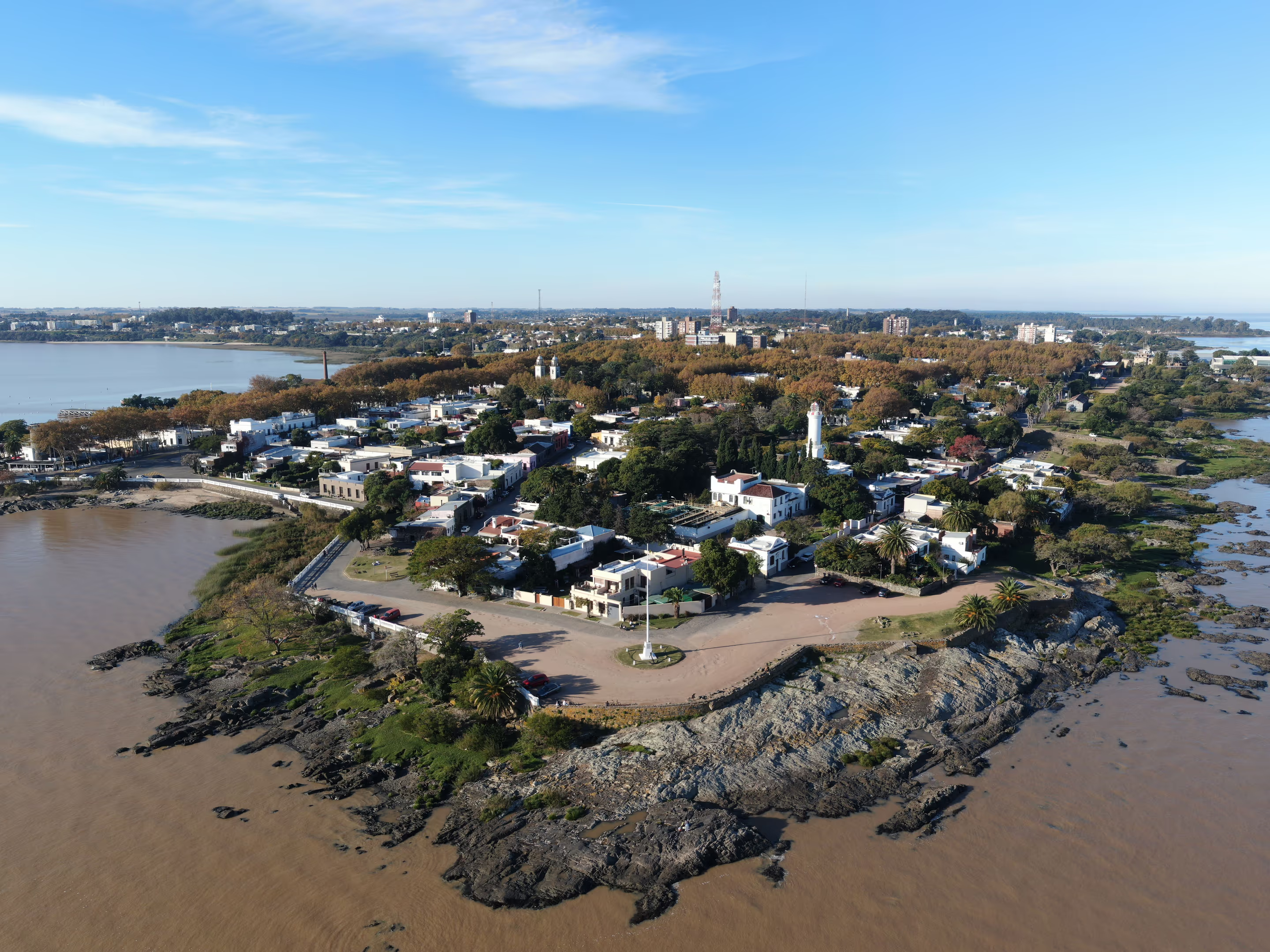
UNESCO’s account of the historic quarter offers a useful way to read that walk. Colonia’s plan follows the shape and topography of its peninsula instead of the strict checkerboard associated with Spanish colonial planning. Its military role also influenced the layout. The result is worth noticing at street level: compare the direction of a lane with the shoreline, then look at how the next small space opens out.
Buildings add a second layer. UNESCO highlights long stone walls, wooden trelliswork and tiled roofs as part of the quarter’s combined Portuguese and Spanish construction traditions, with later contributions from immigrant artisans. Look for those materials and proportions as well as named attractions. They give an ordinary doorway or stretch of wall a place in the town’s history, even when you are simply passing rather than entering a museum.
Start with an easy orientation
Choose a first loop that leaves room to stop. A guided walk can be useful if you want historical interpretation; an independent walk can suit someone who prefers to linger over details. Check the guide's language, meeting point and duration before joining.
A map helps with the shape of the town, but it need not dictate every turn. Keep the return route in mind and let a courtyard, a view or a quiet street become a worthwhile pause.
If you have a particular museum in mind, check its current opening information before making it the centre of the day. Build one confirmed indoor visit into the walk rather than assuming that every small museum shares the same schedule.
Calle de los Suspiros and the lighthouse
Uruguay's tourism office identifies Calle de los Suspiros and the lighthouse as distinctive stops in the historic quarter. The street's irregular paving and the lighthouse's narrow spiral stair are also practical details to consider when planning for mobility or comfort.
Treat any lighthouse ascent as an optional activity whose current access you check on the day. The wider visit does not depend on reaching a high viewpoint. A river-level walk and time among the streets can provide a satisfying sense of the town.
At a popular photo stop, take the picture you want and leave space for other visitors and people using the street. Wait for a clearer moment when practical rather than asking the place to stop functioning for the image.
Keep a wider excursion a conscious choice
Uruguay's tourism information also describes the waterfront route towards Real de San Carlos and its former bullring. If that interests you, treat it as a separate addition to the historic-quarter visit. Check the current access, transport and time required before leaving the centre.
A bicycle hire or an organized outing can change the character of the day. Ask about the equipment, route and return arrangements, and compare the extra time with the hours you have ashore. Do not add an outlying stop simply because the old quarter looks small on a map. It is reasonable to spend the available time exploring that smaller area well.
Use the river as a pause
A waterside stop can give the day a different rhythm from moving between buildings. Sit if there is a suitable place, look back at the town and leave room for a conversation that does not involve deciding the next attraction.
If late light or sunset matters to you, check whether the ferry and terminal reporting time make that possible on your date. Do not assume that a return advertised as an evening sailing leaves time to watch the sunset and still complete the boarding process.
An overnight stay may be the better choice when the evening atmosphere is central to your interest. A day trip is not a failed version of that stay; it simply offers a different part of the day.

Give lunch a sensible place in the plan
A relaxed meal can be one of the pleasures of Colonia, but it should fit the hours ashore. Look at the menu and the setting before choosing a table. A place with a view, a quiet interior and a quick informal stop answer different needs.
Tell the server if you have a fixed departure deadline. If time is limited, ask what can be served comfortably within it rather than placing a large order and hoping the kitchen will infer the urgency.
Choose the size of the meal deliberately
If you want a long lunch, keep the surrounding sightseeing light. If the walk is the priority, a simpler meal can leave more time for it. The strongest day often has one main indulgence rather than several competing reservations.
For a mixed group, check that everyone can find something suitable. Explain dietary requirements directly and ask about the actual preparation. A familiar dish name or a translation on the menu cannot answer every ingredient question.
Avoid treating a restaurant as compulsory because it appears in many photographs. Read the current offer and choose somewhere you will enjoy sitting. The memory may come as much from the pace and company as from a particular plate.
Confirm payment and currency
Before ordering, establish the currency shown and the payment methods accepted. Keep the amount in the currency actually charged when comparing it with your budget. A figure labelled simply with a dollar sign can be ambiguous across an international trip.
Do not assume that payment advice for Argentina automatically applies in Uruguay. Ask the business about its own arrangements and check your card's settled transaction afterwards. If carrying cash, think about a practical amount for the purchases you expect rather than converting a large sum for a short visit.
Keep the receipt where useful, particularly if there is a question about the charge. The aim is to resolve the transaction calmly at the table or counter and continue the day.
Adapt the visit to the people travelling
Colonia's appeal can be gentle, but “a walking day” is not a precise description of effort. Surface, seating, weather and the amount of standing during travel all affect how it feels.
Ask about assistance or access through the operator before booking when that matters. Discuss the vessel and terminal actually used, and confirm whether the service can meet the need rather than relying on a broad accessibility statement.
Travelling with children
Give the day a simple shape: the boat, a manageable walk, a meal and time to pause. Explain the return journey before everyone becomes tired. A small number of clear plans can work better than a succession of places that adults feel obliged to cover.
Bring what you need for ordinary comfort, subject to current baggage and border rules. Keep the documents organized for each child, and allow time for the terminal process without making the whole day revolve around it.
An earlier return or an overnight stay may suit the family better than the longest possible day ashore. Choose by the children travelling with you, not by the schedule another family enjoyed.
Mobility and uneven ground
Check the route you intend to walk and the surfaces around particular attractions. The historic paving that makes a street interesting can make it uncomfortable for some visitors or difficult with wheels.
Plan shorter loops and a place to rest. A guide or arranged local transport may help with a specific need, but confirm the exact service and access before relying on it. The lighthouse stair is optional; it should not become a measure of whether someone has properly visited.
Allow the person with the access requirement to shape the plan. A comfortable meal and a well-chosen stretch of the old quarter can be more rewarding than a larger circuit that leaves them managing avoidable difficulties.
If the weather changes the day
Read the forecast before leaving and pack accordingly. If the weather makes a long outdoor walk less appealing, choose a confirmed indoor stop, a longer meal or a shorter visit. Do not invent an entire replacement programme while the return deadline approaches.
A transport change is a separate question. Follow the operator's communication and contact it about the ticket rather than assuming the weather you see in town determines whether a sailing will run.
Keep the next commitment in Buenos Aires flexible enough that an altered return does not immediately create a second problem.

Return with the evening still easy
Set a time to leave the historic quarter and work towards it gradually. Finish the meal, collect anything stored and make the journey to the terminal before the required reporting time.
The return deserves the same attention as the outward crossing: documents accessible, confirmation ready and the correct instructions for the service. Once those are settled, the final part of the journey can be a chance to rest.
Avoid a tightly timed second event
A performance, an important dinner reservation or a flight immediately after the return turns a pleasant day trip into a chain of dependencies. If that evening event matters, consider visiting Colonia on another day.
For a base around Monserrat and Microcentro, a simple meal near the accommodation may be enough after the crossing. The same principle applies elsewhere: choose the end of the day for how you are likely to feel, rather than for an imagined version of unlimited energy.
Save an ambitious night out for a day when it is the main plan. You will enjoy both experiences more when one does not have to finish perfectly for the other to begin.
Know when an overnight would be better
If the ferry choices leave you with too little time, or if your interest centres on the evening and the following morning, compare a night in Colonia. Add the accommodation, luggage and onward arrangements to the calculation.
An overnight also changes the Buenos Aires side: whether you keep the room, where belongings stay and how you return to the wider itinerary. Compare that complete cost rather than treating one more night as an isolated hotel price.
For some travellers the day trip remains the cleanest fit. For others, the extra night removes enough clock-watching to justify the change. The right answer comes from the experience you want.
Put the day together
Before committing, bring the few important decisions into one plan:
- Choose the purpose. A historic-quarter walk, a river crossing and an unhurried meal are enough reasons to go.
- Read both sailings. Include reporting requirements and the journeys to and from the terminals.
- Check both countries. Confirm the documents and entry conditions for every traveller.
- Keep the visit focused. Choose one main interest and leave room to enjoy the streets around it.
- Protect the return. Allow the terminal margin and keep the evening's next commitment flexible.
Colonia is most rewarding when the journey across the river leads to a day you actually want to have. Resolve the formalities, choose a workable pair of sailings and let the time ashore belong to the town.


