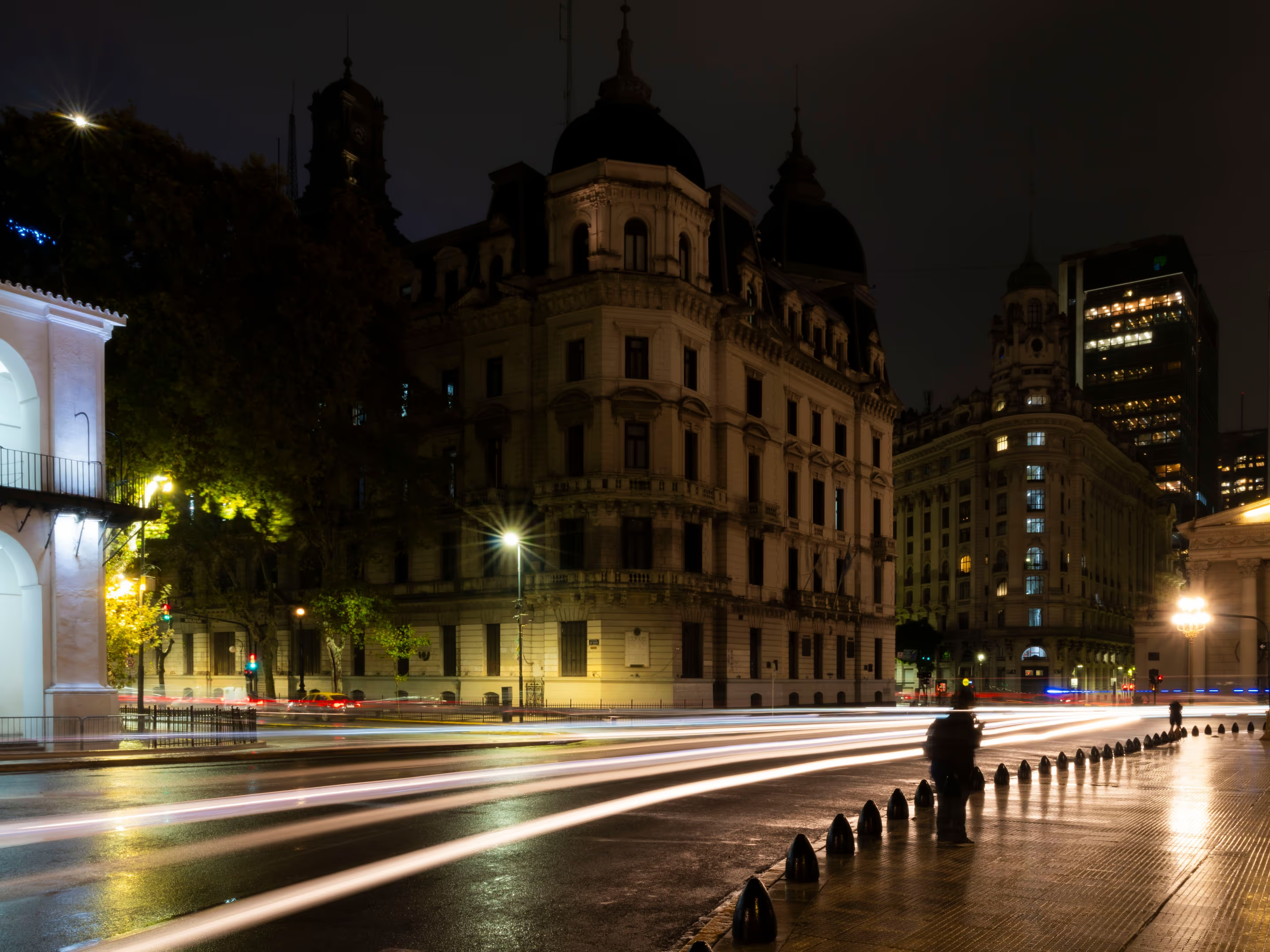
Look up at the balconies. Follow a café conversation into the afternoon. Stay out for the music. Argentina's capital rewards the days you leave a little room to live.
Buenos Aires is a city of layers: formal avenues and intimate interiors, monumental tombs and tables pulled onto the pavement. Its landmarks give you bearings, but the neighbourhoods give a stay its character. Choose a few visits you care about, group them geographically, and let the spaces between them remain part of the day.
01
A first day with a clear centre
Begin around Plaza de Mayo and Avenida de Mayo, then continue towards San Telmo if you want a longer walk. Notice the façades and passages along the way, rather than treating the neighbourhood as the space between attractions.
02
A different day to the north
Make Recoleta a day of architecture, the cemetery and a museum. Give Palermo a separate chapter for parks, shops, cafés and restaurants; trying to cover both completely in one afternoon means moving past much of their appeal.
03
Keep an evening for the city
Choose the experience before the ticket: a staged tango performance, a social milonga, or theatre followed by pizza on Corrientes. Each creates a different evening, and each deserves more than the leftover time after sightseeing.
Palacio Barolo · Buenos Aires
Monserrat and San Telmo
Look up. Then look closer.
The old city is best read in details: balcony ironwork, tiled entrances, worn doors and the proportions of a street corner. Start with the civic setting around Plaza de Mayo, then use Avenida de Mayo and San Telmo to move from monumental architecture into a more intimate scale. The Mercado de San Telmo combines a striking covered interior with food stops; leave time to look at the building as well as its counters.
01
Give the walk a loose shape
Choose two or three places to go inside, with streets and a café between them. Check admission arrangements for any guided building visit before setting the rest of the day around it. A free outdoor alternative is the Costanera Sur ecological reserve, where the city's visitor guide identifies admission as free. Give the paths their own time and check opening and weather closures before going.
02
Make room for another neighbourhood
La Boca has its own history and a distinct visitor area around Caminito. Plan the journey there deliberately rather than assuming every landmark south of the centre belongs on one continuous walk.
Recoleta Cemetery
Recoleta
A city carved in stone.
Recoleta Cemetery rewards close attention: marble, iron gates, narrow passages and mausoleums that reflect different architectural fashions and family histories. Eva Perón's resting place draws many visitors, but it should not become the only point of the visit. Walk slowly and look at the craftsmanship. Outside, the neighbourhood offers a different scale again, with grand façades, garden squares and museums that make a thoughtful second half to the day.
01
Visit with context
Use a map or a well-chosen guided visit to understand what you are seeing. Keep the setting respectful: this remains a cemetery, not simply an architectural backdrop.
02
Pair it with one museum
Choose a collection that interests you and check its current opening day. One cemetery visit, one museum and an unhurried lunch make a more satisfying day than a list of quick entrances. Bellas Artes advertises free activities and collection visits in its official visitor programme; check the current exhibition and any registration requirement rather than assuming every nearby museum has the same admission policy.
Café life · Buenos Aires
Café life
Take the table by the window.
Cafés are one of the most useful ways to understand Buenos Aires. The city's Bares Notables preserve interiors and cultural associations that reach beyond the drinks menu; newer neighbourhood cafés bring a different energy. Make room for both. Try a cortado and a medialuna, notice the room around you, and let a coffee break become time to decide what comes next.
01
An old room, a modern routine
Café Tortoni, Confitería La Ideal and the city's other historic cafés offer different settings. Choose one along your day's route and check its current arrangements if the interior is central to your visit.
02
Let Palermo have its own afternoon
Palermo's parks and its café and restaurant streets are not all in one compact patch. Pick the part you want to explore, then leave time to sit down instead of crossing the whole neighbourhood repeatedly.
Empanadas · From the oven
At the table
Dinner is part of the journey.
A parrilla, a bodegón and a quick food counter offer different kinds of Buenos Aires meal. At a parrilla, the grill is the starting point: choose the cut, ask how large the serving is and agree which sides to share. A bodegón brings a broader neighbourhood table, where a familiar dish and a substantial portion can matter more than ordering several courses. Pizza on Corrientes or empanadas to take away fit a shorter stop between visits. Choose the meal for the time and appetite you have, then use the menu and the staff's guidance to order for your table.
01
Choose a meal, not a checklist
Use ordering at an Argentine parrilla to work through cuts, doneness and shared sides. For a neighbourhood dining room, our bodegón guide explains the menu and the value of asking which dishes and portions suit your group. Confirm a particular restaurant's current menu and reservation arrangements directly.
02
Leave time on both sides
For a shorter meal, Buenos Aires street food explains eating al paso, pizza styles and ordering at the counter. Check whether you order and pay before collecting the food, and choose a place near the part of town you are already exploring. Leave a long seated dinner for an evening when it does not compete with a fixed performance time.
Tango performance · La Ventana
After dark
An evening in another rhythm.
Tango can mean watching a performance, taking a first class or visiting a milonga where people come to dance socially. A stage show offers choreography, lighting and a clear evening programme. A milonga offers a different experience, shaped by its dancers and the customs of the floor. Choose the setting that fits your interest; one does not stand in for the other.
01
Watching or participating
If you want to try dancing, look for a beginner class and confirm whether it is connected to the evening's milonga. If you mainly want to watch, ask the organiser about seating and the format before going.
02
Respect the room
At a social dance, keep clear of the floor, follow the organiser's guidance and ask before photographing people closely. Check the current programme; milongas can move between venues or change nights.
Make the stay work
Good days begin with a little planning.
Use these choices to shape the visit before filling a calendar. Suggested time allocations are editorial guidance; opening days, transport services and admission conditions should be checked for your dates.
01
Where to stay
Pick your everyday neighbourhood.
Palermo suits travellers who want restaurants and café streets to shape their evenings. Recoleta is useful for a quieter base with architecture and museums nearby. San Telmo brings the old city closer; the central districts suit a visit focused on civic landmarks and theatre. Compare the exact address, nearby transport and the return journey after dinner.
Look at the immediate block as well as the neighbourhood name.
Check recent accommodation details for noise, access and arrival arrangements.
02
How long
Give it complete days.
We suggest four or five full days for a first stay with varied interests. With three, choose fewer neighbourhoods and keep the evenings in the plan. With a week, deepen the city stay or add a full day in Tigre. Arrival and departure days are useful bonuses, but unreliable foundations for your most important visits.
03
Getting around
Walk within a district. Connect between them.
Explore a neighbourhood on foot, then use the Subte, buses or a taxi for longer connections. Check a current journey planner rather than relying on straight-line distance. A rechargeable SUBE card is a useful public-transport option; confirm the payment methods accepted by the service you will use. A rental car usually adds little to a stay centred on the city.
04
Arriving and leaving
Read the airport code.
Aeroparque Jorge Newbery (AEP) and Ministro Pistarini at Ezeiza (EZE) are separate airports. Check both ends of every booking and the actual transfer before connecting tickets. Allow time for baggage, immigration where applicable, road traffic and the next check-in. Avoid making a tight airport change the first decision of the trip. The airport-transfer guide compares EZE and AEP arrivals and explains why an airport change needs its own road-transfer plan.
05
When to come
Plan for the season's pace.
Spring and autumn can suit long days on foot; summer brings heat and humidity, while winter shifts more of the day towards cafés, museums and performances. The city works throughout the year if the itinerary matches the conditions. Use the forecast to move outdoor walks between days rather than fixing every hour in advance.
06
Reservations
Check the few things that matter most.
Book ahead for a particular performance, guided architectural visit or restaurant you would regret missing. Check museum closing days before grouping nearby visits. Keep the rest flexible, and confirm details directly with venues: an old schedule should not determine a new trip. For Teatro Colón, start with its official programme and ticket sales and box-office information. Select the performance and seats before arranging dinner; a guided theatre visit is a different booking.
Save the accommodation address and your return transport options.
Keep belongings attended in busy visitor areas, cafés and public transport.
Before you go
Check the current details.
These official city sources support the guide's neighbourhood, café and tango coverage and provide current planning information. Use venue and operator information for your own dates.
Trade the city's streets for a river landscape or open country. Tigre and the Pampas offer different continuations; choose the one that complements the time you have already given Buenos Aires.