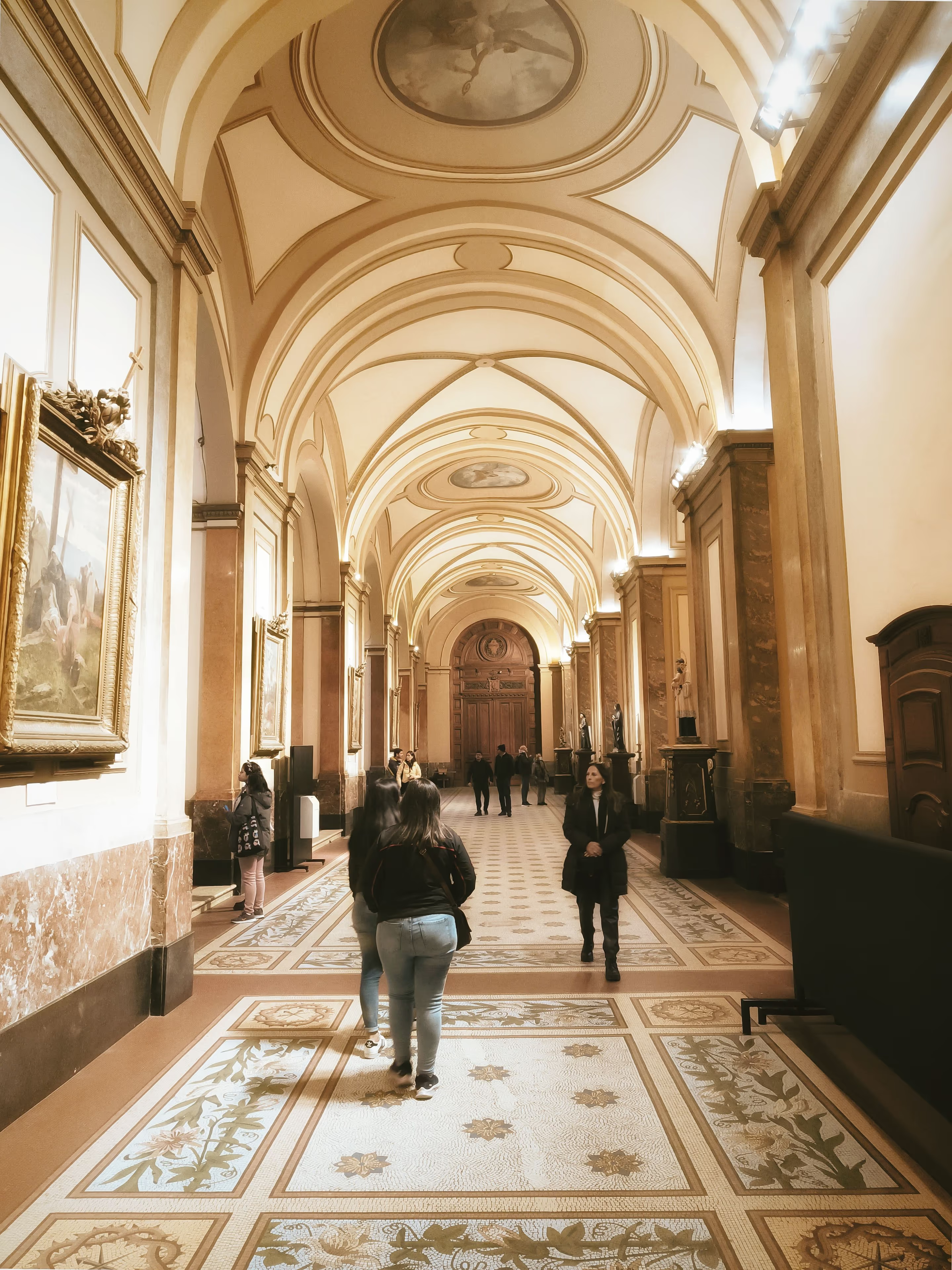
Visitors beneath the arches of a Buenos Aires museum corridor.
Travel on your terms
Make room for your way.
Describe the access you need, ask precise questions and build a route around experiences that work for you. Argentina rewards a plan with the details resolved.
Accessible travel begins with what makes a day work for you. That might mean a step-free route and an adapted bathroom, clear written information, a quieter visit, places to rest or a predictable sequence of activities. A general accessibility label cannot answer all those questions. Ask for the details of the actual room, vehicle and experience being offered, then keep the answers with the booking. Argentina’s great distances make a well-connected plan especially valuable: an excellent hotel cannot fix an unsuitable transfer, and a beautiful viewpoint is less enjoyable if there is no comfortable way back. Build the whole day, including its pauses.
01
Explain your priorities
Describe the assistance, equipment or information you want without assuming the provider understands a broad label. Ask them to respond to those particular requirements.
02
Confirm the complete route
Include arrival, entrances, surfaces, toilets, rest points and the return. A single accessible feature does not establish that the whole experience will work.
03
Keep your choices visible
Say whether you want to travel independently, with your own companion or with arranged assistance. Plan around your preferences rather than a provider’s assumptions.
The falls and surrounding forest at Puerto Iguazú, Misiones.
01 / The falls
Choose the right circuit.
At Iguazú, the park’s official activities guide makes a useful distinction between circuits. The Upper Circuit and the walkway to Garganta del Diablo are described as having no stairs; the Lower Circuit includes stairs that restrict access. That does not make every part of the visit interchangeable. Distance, heat, wet surfaces, rest opportunities and the journey between circuits still matter. Ask the operator about the current route from the entrance, jungle-train boarding, wheelchair arrangements and available toilets. Choose the sections that suit your day rather than treating completion of every circuit as the measure of a successful visit. One well-chosen circuit can be a complete falls experience. For a first day, consider keeping the programme to the confirmed route and an unhurried break, then deciding later whether another circuit adds something worthwhile. This avoids paying for a full sequence before you know how the setting feels.
01
Resolve the transfer
Confirm the vehicle, boarding arrangement and pickup location from your accommodation. Include any equipment dimensions and the assistance you want at each end.
02
Separate boats from walkways
A river excursion has its own boarding and participation conditions. Access to a viewing circuit does not establish suitability for a boat activity; request a separate answer.
03
Build in a pause
Choose somewhere to rest and a clear point at which you can shorten the outing. Let the falls be the main event, with enough energy left for the return.
Visitors looking towards Perito Moreno Glacier in southern Patagonia.
02 / The glacier
A view worth planning.
Los Glaciares National Park lists a ramped route at Perito Moreno, an available chair requiring accompaniment, accessible toilets and ramp access at its cafeterias. It also describes audio guides and Argentine Sign Language information accessed through QR codes. Confirm the current arrangements before travel, including where assistance begins, whether equipment must be requested and which viewpoint the route reaches. The glacier visit is several separate experiences: the approach from El Calafate, the viewing area and any optional boat or ice activity. Decide which of these you want and ask each operator about its own conditions instead of accepting one assurance for the entire day. Ask for a description from vehicle drop-off to the intended viewpoint, rather than a photograph of the ramp alone. Confirm where a companion or arranged assistant can remain with you and how the route works in reverse. These details help turn a listed facility into a usable outing.
01
Ask about the actual surface
Request recent information on the route, gradients and any sections affected by weather or maintenance. Useful access information describes the journey rather than simply calling it easy.
02
Confirm the excursion separately
Boat boarding and glacier trekking involve different requirements from a viewing platform. You can plan a rewarding glacier day around the viewpoints without adding either activity.
03
Keep the return comfortable
Agree pickup timing and the location where the vehicle will wait. Leave time for the café, toilets and any transfer between the viewing route and the departure point.
Buenos Aires offers accessible tourism resources that extend beyond physical entry. The city publishes a communication board using symbols, lists tactile maps at cultural sites and offers selected accessible guided visits with advance registration. Its current programme includes Argentine Sign Language interpreters and three-dimensional replicas on specified visits. These are promising starting points, but dates, language and the individual venue still need to match your plans. A museum afternoon can also be arranged around seating, quieter periods, lighting and the information format you prefer. Choose a small group of nearby places so the day is shaped by the art and architecture rather than repeated difficult transfers. An afternoon with one cultural visit and a nearby café may offer more enjoyment than several buildings spread across the city. Compare the transfer effort with the time you want inside each place, and keep enough space to stay longer when an exhibition interests you.
01
Choose the information format
Ask about audio description, captions, readable text, hearing support or a guide’s language as appropriate. A resource in one format or language does not substitute for another.
02
Check the usable entrance
Request the address of the entrance you will use and the route from the drop-off point. Historic buildings can have different visitor entrances with different arrangements.
03
Make the café part of the plan
Confirm the route to the table and toilet as carefully as the museum itself. A reliable place to pause helps turn individual visits into a comfortable city day.
Send a short, specific checklist to each provider and keep the reply. Recent photographs, measurements and a named contact are more useful than a general assurance.
01
Accommodation
Confirm the exact room
Ask the hotel to identify the room category and features it is reserving for you. Clarify whether the photographs show that room, whether a lift is needed and how you reach breakfast and other shared spaces.
Request doorway widths, bed height and turning space if relevant.
Confirm shower, toilet and transfer arrangements.
Ask what happens if the assigned room becomes unavailable.
02
Flights
Arrange the assistance early
Tell the operating airline what assistance you need and whether you will bring a mobility device. Ask about the device’s dimensions, weight and battery requirements, along with boarding and return arrangements. Medical clearance and routine assistance are different processes; confirm which, if either, applies to your circumstances.
Keep the assistance request with the booking reference.
Check every operating airline on a connecting journey.
Arrange any transfer between airports separately.
03
Ground transport
Name the vehicle and method
Ask how you will board, whether you can remain in your chair if needed and what restraint or storage arrangement the vehicle provides. Confirm the actual vehicle for each journey rather than assuming every service in a company’s fleet is the same.
Share the dimensions and requirements that affect boarding.
Confirm assistance at the accommodation and arrival point.
Keep an alternative contact for a missed pickup.
04
Day design
Leave room to rest
Build the itinerary around a pace you can enjoy over several days. A short activity can still demand a long transfer, standing in a queue or time in bright sun. Put a quieter option alongside a more demanding outing without treating it as a lesser experience.
Plan useful breaks and accessible toilets.
Ask about waiting, shade and seating.
Keep departure and return times realistic for your needs.
05
Communication
Make information usable
Tell providers how you prefer to receive information and decisions. Written pickup instructions, a visual schedule or a calm explanation in advance can resolve uncertainty that a generic welcome message leaves untouched.
Ask for key arrangements in your preferred usable format.
Save addresses and instructions offline.
Confirm the language and format of any guided interpretation.
06
Changes
Keep a workable alternative
Ask who will contact you if a lift, route or vehicle becomes unavailable and what replacement can actually meet your requirements. Check booking and cancellation terms before paying for an experience whose suitability is still unresolved.
Retain the specific access commitments in writing.
Identify a named contact at each main provider.
Choose a nearby alternative you would genuinely enjoy.
Useful visitor information
Before you book.
These official resources describe available programmes and facilities. Confirm the arrangements for your dates and requirements directly; the photographs illustrate the destinations and do not certify access.
The glass dome and ornate interior of Galería Güemes, Buenos Aires.
Travel with the details settled
Keep the experience yours.
The reward for asking precise questions is a trip that reflects what you came for: the force of the falls, the blue edge of a glacier or light moving through an old arcade. Choose the experiences that interest you, then give each one a route, a pace and the support that suits you.