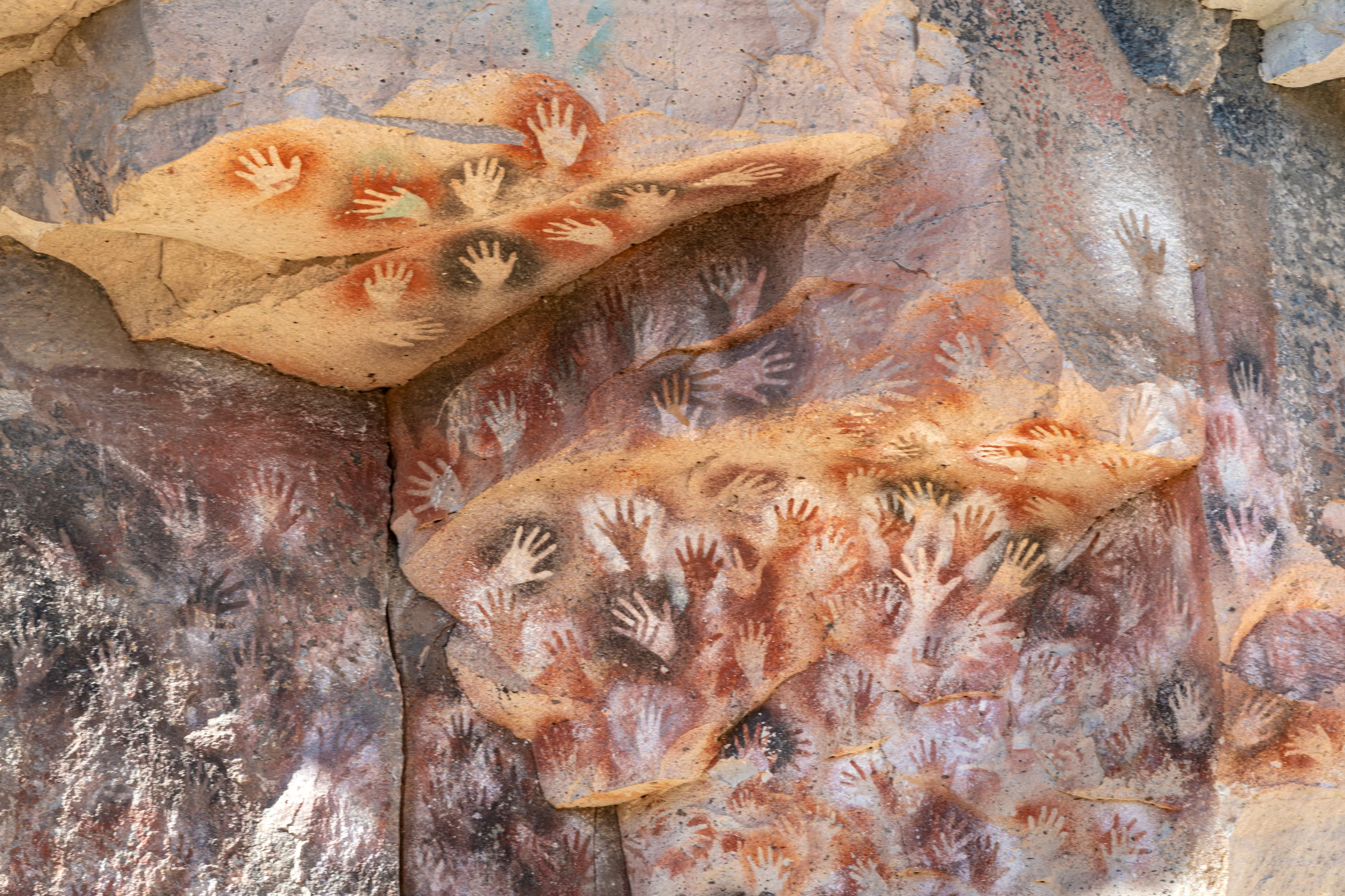
Cueva de las Manos · Hand stencils on the painted rock
Cueva de las Manos · Río Pinturas, Santa Cruz
Cueva de las Manos
Hands overlap on a rock wall above the canyon. Animals and hunting scenes carry other traces of lives lived here thousands of years ago. Come for the paintings, and leave time to understand their setting.
Cueva de las Manos sits in the Río Pinturas canyon, far north of the glacier towns most visitors associate with Southern Patagonia. Its painted shelters preserve evidence of people returning to this landscape across thousands of years. Hand stencils are the best-known images, but animal figures and hunting scenes are central to the site's significance too. A guided visit gives those details a context that a quick photograph cannot. Build the stop around the northern Santa Cruz road network, commonly using the town of Perito Moreno or another confirmed regional base. This is a separate journey from Perito Moreno Glacier near El Calafate, despite the shared name.
01
Treat the site as the purpose of the day
Leave room for the access road, the guided circuit and time with the interpretation. A short-looking detour on the map can involve slow gravel sections. Avoid fitting the essential visit into the narrow gap before a long, inflexible drive.
02
Know which Perito Moreno you mean
The town is a northern Santa Cruz service base associated with the archaeological site. The glacier is much farther south in Los Glaciares National Park. Use full place names when booking accommodation, transport or an excursion to prevent an expensive misunderstanding.
03
Look beyond the hand stencils
Ask the guide about animal figures, superimposed images and the relationship between the shelters and the canyon. The paintings are evidence of human activity, not a decorative backdrop. You will get more from the visit by noticing differences than by collecting one familiar view.
Cueva de las Manos · Layers of hand stencils across the rock
People, animals and returning generations
A wall made over many lifetimes.
The painted panels were not produced in a single moment. Research identifies a long sequence of activity, with later figures sometimes placed over earlier work. Hands, guanacos and hunting scenes give visitors different things to notice, while mineral pigments create the distinct colours across the rock. The site's importance lies partly in this continuity and variety: evidence of early hunter-gatherer societies preserved within its original setting. Let the guide explain what researchers can establish and what remains uncertain. There is no need to invent an individual story or a ritual meaning for every hand in order to find the work moving.
01
Start with the visible details
Look at the relation between colours, shapes and overlapping figures. Ask which differences indicate separate periods and which interpretations remain open. A careful explanation is more rewarding than treating every image as if its meaning were fully known.
02
Keep the people in the story
The landscape was inhabited and understood long before the modern road network. Consider the skills, movement and repeated choices represented by the art. Avoid describing the canyon as an empty wilderness simply because the present-day drive feels remote.
Cueva de las Manos · Painted figures on the textured shelter wall
Rock shelters in Río Pinturas country
The setting belongs to the artwork.
The shelters and painted walls form part of the canyon landscape, with the river and the surrounding steppe providing the wider setting for human activity. UNESCO recognises the relationship between the art and its environment as part of the site's value. During the visit, look away from the panels as well as towards them. The position of the shelter, the scale of the rock and the contrast with the country above help you understand why the place matters as a whole. This does not require extending the excursion into an improvised canyon walk. The designated circuit and the guide's explanation can provide a strong sense of context.
01
Ask how people used the landscape
Animals depicted in the art connect the panels with the surrounding country. Discuss what the archaeological evidence suggests about movement and hunting, while keeping the distinction between evidence and speculation clear.
02
Leave the surrounding ground undisturbed
Small objects and fragments can have archaeological significance that is not obvious to a visitor. Follow the marked route and leave material where it is. The setting deserves the same attention as the most recognisable painted panel.
Cueva de las Manos · Ancient pigment against the rock surface
Museums and a longer northern route
Give the visit another layer.
The nearby town of Perito Moreno makes a useful place to seek accommodation, supplies and further archaeological context. Its Museo de Arqueología Carlos Gradin belongs naturally with a visit to the painted shelters. With more time, the broader northern Santa Cruz route can include the Cañadón Pinturas area, the steppe of Parque Patagonia and journeys towards Los Antiguos or Lago Posadas. Those are separate outings with their own access and distances. Choose the continuation that suits the available days rather than drawing one large loop simply because the names appear close together on a regional map.
01
Use a museum to extend the questions
A museum visit before or after the site can help place the paintings within the wider archaeological record. Confirm current opening arrangements and allow time for interpretation. It is a different experience from seeing the art in the canyon, and a useful complement.
02
Distinguish the site from nearby portals
Parque Patagonia's named portals and walking areas are not all the archaeological site's entrance. Confirm the exact destination and access route before driving. A canyon hike, a campsite and the guided paintings circuit require different amounts of time and preparation.
A worthwhile detour needs a clear plan
Make room for the place itself.
The main practical decisions concern the base, the access road and the time available for a guided visit.
01
Getting there
Use current access information.
The official site identifies gravel approaches via Provincial Routes 97 and 101 and links to provincial road information. Plan the guided Cueva de las Manos visit around arrival at the archaeological site; an independent hike in the Pinturas canyon is a separate outing, not a substitute for its guided circuit. Choose the road according to your starting point and current conditions, rather than relying on the shortest line offered by a navigation app.
Confirm the exact visitor-centre destination.
Save the route and contact details before leaving reliable coverage.
02
A guided visit
Allow more than the time at the panels.
Municipal visitor information describes the Bajo Caracoles and RP 97 approach as roughly 47 kilometres of gravel. Allow for that drive before the site’s admission and guided-circuit arrangements, with time to check in, wait if needed and return along the designated route. Advertised opening hours are not necessarily the same as the final available tour departure; neither the road nor a canyon hike should be assumed accessible in bad weather.
Ask about the last guided visit for the day.
Check language options and any group arrangements in advance.
03
Where to stay
Choose a base with useful services.
The town of Perito Moreno offers a wider range of accommodation and services than the remote access roads. Other regional stops may work for a through journey, but confirm the specific room, meal and fuel arrangements rather than assuming availability. A night before or after the visit can remove the pressure of a very long driving day.
Use full place names on every booking.
Keep the next morning's driving distance realistic.
04
Walking and access
Ask about the actual circuit.
The archaeological visit involves an outdoor path and time beside the shelters. Ask the site about the current surface, gradients, steps and available assistance if these affect your visit. A guided circuit is not automatically step-free, and an exposed canyon day can feel different from conditions at the accommodation.
Wear suitable footwear and bring layers.
Discuss specific access needs directly with the site.
05
Season and weather
Plan for the road as well as the art.
Check the official current visitor arrangements for seasonal hours and tariffs. Weather can affect access and the visit itself, so check before committing to a remote drive. Warmer-season daylight can make a longer regional itinerary easier, but does not remove the need to verify gravel-road conditions.
Carry water and food for the journey.
Leave space to adjust the day's route when necessary.
06
Care for the site
Keep the encounter observational.
Stay behind the barriers and follow the guide's instructions about photography and movement. Touching painted rock, adding marks or removing fragments damages the evidence that makes the place valuable. There is plenty to notice without getting closer than permitted: the irregular surface, layers of colour and the relation between one figure and the next.
Let the guide set the pace around the panels.
Leave the art and its surroundings as you found them.
Useful visitor information
Plan with the latest local details.
Official and specialist information for the places in this guide.
The road back crosses a place with a much longer human history than a first impression suggests. Carry that perspective into the rest of the journey through Santa Cruz.