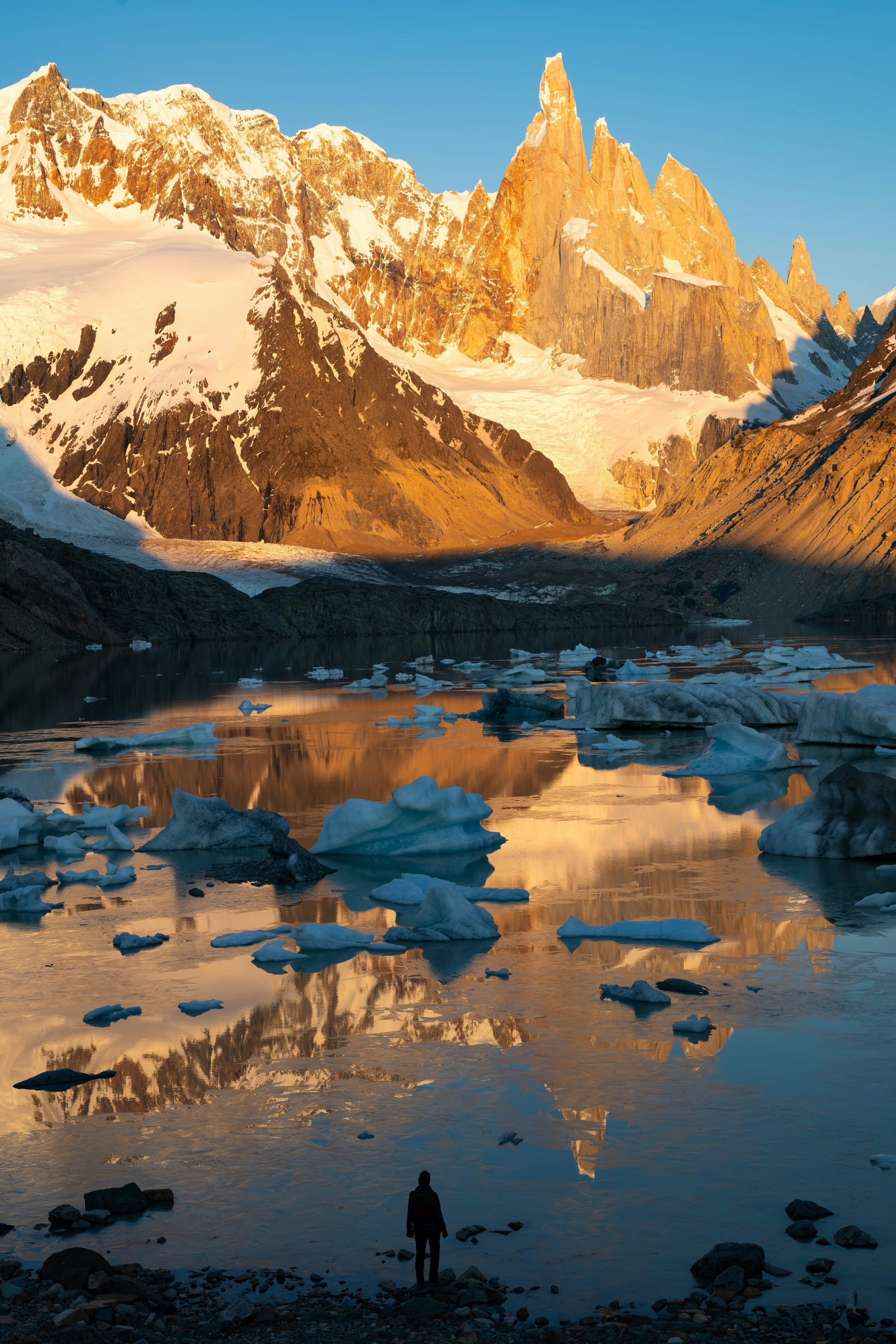
Laguna Torre · First light across the ice and mountains
Laguna Torre · River, forest and glacier
Laguna Torre
The river leads through the trees. Beyond the moraine, ice rests on a mountain lake and granite needles rise into cloud. Follow the valley for a different kind of El Chaltén day.
Laguna Torre follows the Río Fitz Roy valley towards a glacial lake beneath the Cerro Torre group. Forest, river and moraine give it a different character from the Laguna de los Tres approach. The usual lake route is about 18 kilometres return, with roughly six to eight hours a useful broad planning range, depending on pace, pauses and conditions. There is less concentrated climbing than on the final ascent to de los Tres, but this remains a long day, with uneven ground and exposure near the lake. Choose it for the whole landscape. The glacier, water and valley can be compelling even when cloud hides the highest needles.
01
Make the lake the main objective
The standard return walk gives the day a clear shape. Optional extensions add distance and exposure, so leave them out of the basic plan unless they are a deliberate, informed choice. Reaching the lake and returning comfortably is a complete outing.
02
Keep the first viewpoint as a shorter choice
Mirador Cerro Torre offers an earlier look towards the mountains. It can be a good objective for a shorter day or a group that does not want the full lake distance. Choose that turn point before setting out, and check the actual current route.
03
Compare the terrain, not the reputation
Torre is often described as the easier of the two famous lake walks. That comparison refers mainly to the pattern of climbing. It says little about the wind, surface conditions or the effort of a long return on the day you are there.
Torre valley · Snowy mountains beyond the lower approach
The lower route and mountain outlook
Follow the openings in the forest.
The route leaves town towards the Río Fitz Roy valley, with initial climbing and viewpoints before the longer approach to the lake. Forest gives shelter in places and creates a changing frame for the mountains ahead. Choose Mirador Torre as the shorter destination: the Mirador Torre and Laguna Torre route map estimates 3 kilometres and about 1 hour 15 minutes outward to the viewpoint, compared with 9 kilometres outward to the lake. Add return time to either plan. These are map estimates, not a promise for your pace or conditions; the mirador lets you see the valley without committing to the full lake day. Farther on, the route moves between trees and more open ground. Treat those changes as part of the interest rather than trying to hurry through everything before the lake. This is a walk in which the approach helps explain the final landscape.
01
Use the first viewpoint to take stock
Compare your pace and the conditions with the plan you made in town. A comfortable arrival here does not erase the remaining distance. If the shorter objective suits the day better, enjoy it and return without turning the decision into a disappointment.
02
Keep the group together through the junctions
Use the current map and marked trail, and agree on meeting arrangements before any separation. A familiar-looking path is not a reliable substitute for knowing the route. Phone reception should not be the plan for finding one another.
Laguna Torre · The glacier and mountain basin
De Agostini and the lake basin
The forest opens to a glacial world.
The approach reaches the De Agostini camping area before the final arrival at Laguna Torre. The lake is enclosed by rough moraine, with Glaciar Grande and the Torre group beyond. The shift from forest to open glacial ground is part of the drama: trees give way to stone, water and ice on a much larger scale. Conditions at the shore may feel markedly colder and windier than the sheltered approach. Add a layer before settling down, keep the return time in mind and enjoy the view from established areas. The presence of a glacier in the scene does not make the ice itself part of the ordinary walking route.
01
Allow time to look across the basin
The glacier's texture, the debris around the lake and the peaks behind it offer different points of interest. A clouded summit does not remove everything worth seeing. Look at the landscape that is visible rather than waiting only for one familiar outline.
02
Treat camping as a separate itinerary
De Agostini is a named camping area on the park map. If staying overnight, confirm current permissions, services and rules before leaving town. An overnight plan adds equipment and responsibilities; it is not an assumption to make after a late arrival at the lake.
Laguna Torre · Ice fragments on the lake
Wind, water and the optional extension
Let the lake be enough.
Pieces of ice can change the foreground at Laguna Torre, giving the same mountain setting a different mood from one visit to another. Their presence and position are variable, and no photograph promises the scene you will find. Stay on suitable established ground and watch the water without approaching unstable ice or steep edges for a closer picture. Mirador Maestri lies beyond the standard lake arrival on an exposed moraine route. It can offer another glacier angle, but it adds a different section of terrain. Decide with current park advice and the conditions at the lake, rather than continuing simply because a path extends farther.
01
An extension needs its own decision
The Maestri route is exposed to wind and adds both outward and return distance. Leave it out when conditions, time or the group's footing make it unsuitable. The main lake visit already contains the river, forest and glacier story.
02
Take a photograph without changing the risk
The texture of ice and the light on the water can be photographed from the permitted route. A small shift of viewpoint is enough when the scene is strong. Do not step onto ice or descend unstable shore slopes for the image.
A clear plan for the lake and return leaves more room to enjoy the route, especially when the weather changes.
01
Distance and pacing
Plan from your actual starting point.
The park map places the lake around nine kilometres from the trail start. Include the walk from your accommodation and any chosen extension separately. The broad six-to-eight-hour day is a planning guide rather than a guaranteed duration. Use the current route information, your group's pace and daylight to set an appropriate start and turnaround plan.
Do not add Mirador Maestri to the standard distance unnoticed.
The return takes time even when the outward walk has felt comfortable.
02
A shorter visit
Choose Mirador Cerro Torre deliberately.
The earlier viewpoint gives a shorter way into the valley and can fit a lighter day between bigger outings. It is still a walking route with climbing and mountain weather. Confirm the distance from your chosen start, then enjoy the viewpoint as the purpose of the day. There is no requirement to continue to the lake once the planned outing has delivered what you wanted.
Use the same map and weather preparation as for a longer route.
Keep time for a meal or town afternoon after returning.
03
Wind and clothing
Prepare for the open lakeshore.
Carry suitable footwear, food and water, with layers for a cold or wet stop. A light and an offline map belong in the day pack even when the plan is to return before dark. Strong wind can change the experience of the exposed basin and moraine. Conditions in the village or sheltered forest are not a reliable description of the whole walk.
Consult the national park information centre before departure.
Give the exposed extension a separate weather decision.
04
Season and entry
Confirm the current arrangements.
The lower valley and upper basin can have different snow and surface conditions. Autumn colour can accompany a cold day; winter can make an otherwise familiar trail a different undertaking. Check the official park tariffs and El Chaltén access guidance for admission, alongside current route conditions and any required registration. From May to September the park requires trail registration, with separate requirements for climbing and remote trekking.
Use the latest park guidance for the specific date and route.
An older guide describing free or unrestricted access is not current confirmation.
05
Linking the two valleys
Madre e Hija is a larger route choice.
The park map shows a connection between the Fitz Roy and Torre trail systems through the Madre e Hija area. That does not make the two famous lake walks a simple combined day. Reaching the connecting paths already involves substantial walking, and the full itinerary needs a careful distance, timing and access plan. Seek current park guidance before choosing it.
For a first stay, separate lake days usually make the choices clearer.
Do not add a connecting trail to salvage a route that is already running late.
06
The day after
Let the next outing feel different.
A village morning, Chorrillo del Salto or one of the closer viewpoints can be a welcome change after the lake. If Laguna de los Tres is next, give its steep upper section the respect of fresh legs and suitable conditions. A flexible El Chaltén stay makes it easier to choose a rhythm that fits the people travelling.
Keep at least one shorter option in the stay.
Choose the order of the major walks after arriving, with local information.
Useful visitor information
Plan with the latest local details.
Official information for the places and routes in this guide.
Laguna Torre · The lake held beneath mountain cloud
A different mountain day
Follow the river back to town.
The lake is the turning point, but the valley makes the walk. Give the return its own attention, then enjoy an evening with the next day's plans still open.