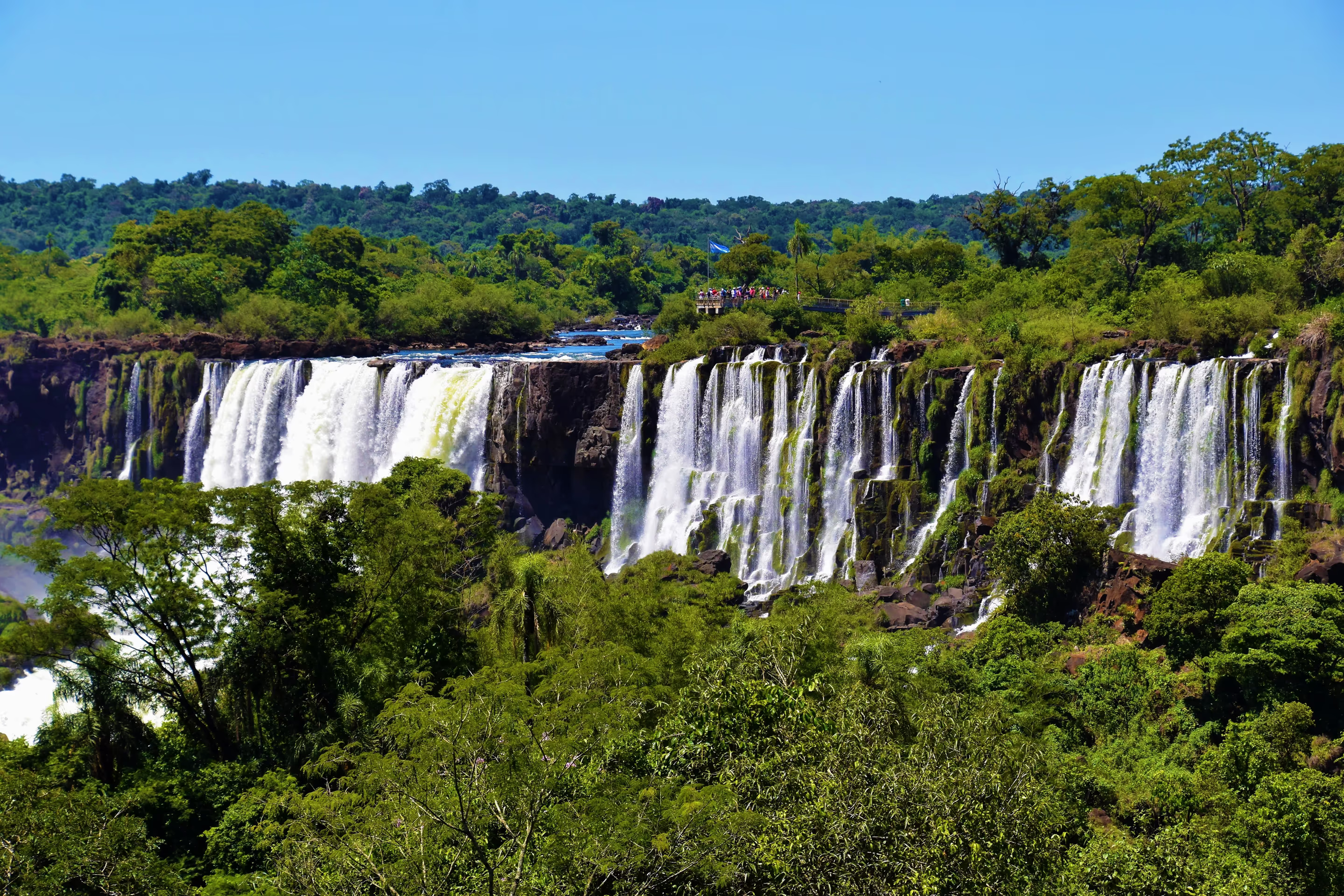
Two perspectives on the falls
Iguazú: Argentina, Brazil or both?
Compare the circuits, broad views, walking demands and border logistics before choosing one side or giving each park its own day.
Argentina and Brazil offer different ways to experience the same river. Choose by the kind of day you want, the routes currently available and the practical journey from your base.
Two parks, two ways to meet the same river
The question sounds simple: should you visit Iguazú from Argentina or Brazil? The useful answer depends on how you like to spend a day. Argentina offers several circuits that divide the falls into a succession of encounters. Brazil's principal visitor route gives a broader view across the system, followed by a closer approach beside the water. Neither experience makes the other redundant.
If your time, documents and budget allow, give each park its own day. You can then enjoy the difference instead of comparing two rushed visits. If you have only one day, choose the experience that suits your interests and your actual starting point. A border crossing is part of the journey, not a line you can erase from the timetable because the parks look close on a map.
The Argentine Iguazú Falls guide covers the practical park day, while Brazil Pronto's Iguaçu Falls guide helps with the Brazilian visit. Read the two alongside each other before buying transport. The names Iguazú and Iguaçu refer to the same wider landscape in Spanish and Portuguese, but the admissions, visitor systems and entry requirements belong to separate countries.
Choose by the visit you want, then make the logistics support it. If you enjoy several walks with changing viewpoints, start by looking at Argentina. If you want the broad arrangement of the falls to become legible in one principal route, examine Brazil. If reduced mobility or limited energy is the deciding factor, compare the precise accessible routes currently available rather than relying on either country's general reputation.
Check current access before imagining a particular viewpoint
River conditions can change which parts of either park are available. A park may remain open while one famous walkway is closed. On 17 September 2026, Argentina's park authority reported that the Garganta del Diablo walkways had been removed preventively in August, while other principal visitor areas continued operating. That dated notice is a reason to check the current circuit report, not a promise about your eventual visit.
The comparison below describes the established experiences when their routes are available. Before committing to a day centered on a particular circuit, consult the park's latest information. A photograph, a general activities page or a ticket on sale does not establish that every pictured viewpoint is open. Keep this distinction in mind on both sides of the border, using Brazil's current visitor guide for its visitor routes.
Argentina: a day built from several walks
The Argentine visit rewards a willingness to spend time moving between different parts of the falls. The park's official descriptions distinguish the Upper Circuit, Lower Circuit and Garganta del Diablo approach, along with forest routes. You are choosing among several experiences rather than following one continuous sightseeing corridor from arrival to departure.
The Upper Circuit, listed by APN as approximately 1,850 metres, uses step-free walkways to look across the river as it approaches the drops. The Lower Circuit is approximately 1,750 metres and includes stairs, bringing visitors closer to individual falls. The Garganta approach, when available, crosses the upper river on a roughly 1,100-metre step-free walkway. These are descriptions of individual routes, not the total distance you will cover in a day.
That distinction is worth keeping on your planning sheet. There is also the movement from the entrance, between facilities and to the relevant transport or path. A short-looking circuit can become part of a longer day once you add connections, meals and pauses. Read the day's current park information before deciding which sequence suits you.
Choose a sequence, not a race
For a first visit, identify the circuit you most want to experience and build around it. Then add the next route if time and energy allow. This approach gives you a satisfying day even if a queue, a rain shower or an access change interrupts the original order. A list of every available attraction is useful background, but it does not have to become a personal obligation.
If you are traveling with someone who walks more slowly, discuss the pace before entering. A shared day works better when both people know whether you intend to remain together or meet later at a clearly identified place. Noise, crowds and a large visitor area can make vague arrangements inconvenient. Choose a meeting point you can both recognize, with a time that leaves room to get there.
The train is part of the internal visitor system, not a direct substitute for the whole walking day. APN lists the ecological train among the facilities included in admission. Check its current operation and how it connects with the circuits you plan to use. Do not assume that boarding a train removes the need to walk to and from a particular viewpoint.
Leave the forest option room to be itself
APN describes the Macuco trail as a more natural, pedestrian route of approximately seven kilometres return. If this is an important part of your visit, discuss conditions and preparation with park staff. It is a separate choice from the principal falls walkways, with its own demands on time and energy.
A traveler interested in the forest may prefer a second Argentine day to squeezing the trail into a full circuit schedule. Someone focused on the falls may be happier with fewer walks and longer pauses at the viewpoints. Neither approach is a lesser visit. Decide what draws you here before filling every available hour.

Brazil: read the falls across the landscape
The Brazilian visitor guide describes a journey from the visitor centre by internal park bus to the Trilha das Cataratas. The main trail opens views across the falls before reaching the walkway and the Garganta do Diabo outlook. The appeal is the relationship between the individual cascades and the wider scene: you can see how much water, forest and space belong to the same landscape.
The concession's regular admission information includes internal transport, the main falls trail, elevators, walkway and principal viewpoints. It describes the walking section as approximately one kilometre. That figure does not represent the entire visit from your hotel and back, and it does not make the journey automatically effortless. You still need to account for arrival, boarding, stops and the route appropriate to your needs.
The broader views can make Brazil a useful introduction before an Argentine day of closer encounters. Reversing the order can be equally rewarding: after exploring individual circuits, you may enjoy seeing how those pieces relate from across the river. There is no necessary sequence that every traveler should follow.
A shorter main trail does not require a short visit
The Brazilian side is often squeezed between arrival and another appointment because its principal walking route is relatively compact. That can work only if the full transport chain is realistic. A relaxed visit leaves time to stop, watch the changing spray, eat and move through the park without constantly checking the departure time.
Someone who dislikes a long succession of circuits may find this structure appealing. A photographer may prefer to spend longer at a few viewpoints. A family may value a day with a clearer central route. Those are preferences, not evidence that Brazil is inherently better or easier for every visitor.
If you are tempted by an additional experience advertised by the concession, examine its separate booking conditions. A sunrise or sunset product is not simply a different arrival time on any ordinary ticket. Read the specific inclusions and the transport arrangements that go with it. The regular visit is already a complete way to encounter the falls.
What changes when you see both?
A second park day offers a change of perspective rather than a second copy of the same outing. On the Argentine side, the route can feel like a series of chapters. On the Brazilian side, the wider arrangement becomes more apparent. The contrast may help you understand why a single photograph rarely explains the scale of the place.
Do not turn that comparison into a competition while you are there. Watch how the view changes as you move, how the forest frames the water and where the river seems calm before it drops. Those observations give the second day a purpose beyond proving which country has the best viewpoint.
The practical difference is just as important. Each park has its own admissions and visitor services, so organize two complete visits. An Argentine ticket or pass does not cover entry to Brazil's park. A transfer advertised as “both sides” should identify what is included on each side, along with the border process and return arrangement.
One day available: choose the strongest fit
If you have one full day and are already staying in Puerto Iguazú, an Argentine park day may be the simplest way to devote your time to the falls. The same logic applies to someone already based in Foz do Iguaçu who prefers the Brazilian experience. Your base is a practical advantage, not a verdict on the landscape.
If one particular view is your reason for traveling, establish its current availability before deciding. Then consider walking demands, transfer time and the documents needed for the route. A compact itinerary that matches your priorities is more rewarding than a theoretically comprehensive one that depends on every connection running perfectly.
Trying to see both parks in one day creates a different kind of visit. It may be offered as an excursion, but it leaves less room for independent pacing and makes border timing more consequential. Read the actual sequence, walking time and exclusions before choosing it. Do not assume that “both sides” means every major circuit.
Two days available: protect two useful park days
With two days, arrange one for each side and keep the evenings uncomplicated. Where practical, avoid using the first day as both a late arrival and an ambitious park visit. Similarly, do not place an international departure immediately after a cross-border return unless the whole plan has a generous, credible margin.
The best order may come from current openings, ticket availability or your transport arrangement. Let those practical details guide you. A rigid rule about which side must come first adds little when your dates or mobility needs point another way.
If you can add another night, use the extra space according to your interests. It might support a slower second Argentine visit, a forest activity or simply an arrival and departure that do not consume the two park days. Count usable days, not just hotel nights, when comparing itineraries.

Treat the border as a real journey
A visit to the other side is an international trip even if you return to the same hotel that evening. Check Brazil's requirements for your nationality and travel purpose, along with the requirements for returning to Argentina. Having permission to visit one country does not establish permission for the other. Consult the responsible consulates and the official immigration information before buying a nonrefundable excursion.
Carry the original travel document required for your circumstances. Families should check any additional rules that apply to children and the adults accompanying them. A driver's assurance that the journey is routine is useful logistical context; it does not replace the entry requirements. The same applies to a tour description saying that the crossing is “easy.”
Choose transport with a clear explanation of the crossing process. Ask whether it is a direct service or requires a change, what passengers do at each control, where the vehicle waits and how the return works. These questions are especially useful if you do not speak Spanish or Portuguese confidently. Save the instructions where you can retrieve them without relying on reception.
Compare independent and organized transfers
An organized transfer can reduce the number of decisions on the day. It can also set a fixed pace or departure time that does not suit the visit you imagined. Ask how long you will actually have inside the park, whether entry is included and whether the return is shared with people visiting other attractions.
Independent transport gives you more control only if you understand the connections. Check the current services for your exact origin and destination, including the final return. A fare to the border is not necessarily a fare to the park entrance. If the journey requires another vehicle after immigration, include that in both the cost and the time allowance.
For a private transfer, agree the pickup location, waiting arrangement and destination after the visit. If you are carrying luggage or need a child seat or accessible vehicle, settle that in advance. A clear written description prevents a small practical detail from consuming the morning you intended to spend beside the falls.
Compare the complete cost
Price the day from your accommodation back to your accommodation. Include park entry, transport, any separate activity, food and the cost of services you need. The cheaper admission may not produce the cheaper overall day if it requires a more expensive crossing or transfer.
Use the official ticket pages for current categories and eligibility. The Brazilian concession currently requires online booking with a selected date and time; check those instructions as you purchase. Do not select a discounted category simply because its label sounds familiar. Read the evidence required and carry it with you.
For Argentina, use the APN tariff page and official ticket route. If you are considering another Argentine park day, compare the current admission products for your actual schedule. Do not assume a remembered second-day discount still applies. The reservations and park access guide explains the wider pass choices, but a pass must match the park and dates in your plan.
Keep extras separate from the core visit
A boat trip can be an exciting addition, but it is not necessary to make the falls visit complete. It also has its own participation restrictions, meeting point and preparation requirements. Read the operator's current conditions before promising it to everyone in your group.
Ask whether an excursion price includes the park admission or only the activity once you are inside. Allow time to reach the meeting point from the entrance and to reconnect with your return transport afterward. A low headline price is not a useful comparison if another offer includes those pieces.
Meals deserve the same practical treatment. Decide whether you want a reserved restaurant stop or a flexible day with simpler food. If a group excursion includes lunch, find out when and where it happens. You may prefer the convenience, or you may value the freedom to eat when you are ready.
Access is a route question
Avoid reducing accessibility to the length of the principal trail. Argentina's Upper Circuit and Garganta approach are described as step-free, while the Lower Circuit includes stairs. Brazil provides accessible transport and access to principal viewpoints, with elevators and alternative routing. Current operation, temporary closures and the journey between these facilities still matter.
Contact the relevant park about your specific needs. Describe whether you use a wheelchair, need to avoid stairs, cannot stand for long or need frequent rest stops. Ask about boarding the internal transport, the distance to viewpoints, accessible toilets and any assistance that must be arranged in advance.
If one facility is essential, such as an elevator or adapted vehicle, confirm its availability near the visit. An accessible route shown on a map may depend on that facility. Also ask what alternative is available if the route changes on the day. This creates a more useful plan than assuming the whole park shares a single access standard.
Match the pace to your group
A group with different walking preferences can choose a smaller shared programme and leave optional additions for those who want them. Agree the meeting point and return time before separating. Use a location that everyone can reach comfortably, rather than the most dramatic viewpoint on the map.
With children, build in food and rest before they become urgent. A change of clothes or a protected bag for wet items may be more useful than another piece of camera equipment. Decide how much of the day you want to spend walking and how much you want available for unplanned pauses.
For anyone who finds heat, noise or crowds tiring, consider how to make the day manageable rather than simply adding more attractions. Discuss quieter rest options with staff, keep the return journey straightforward and leave the evening free. The aim is to enjoy the falls at a pace you can sustain.

Pack for water, walking and a full day out
Bring footwear suited to wet walking surfaces and the routes you have chosen. Protect electronics and important documents from spray and rain. A bag that keeps your hands free makes it easier to move along walkways and use railings where appropriate.
Carry water and plan food around the facilities and rules of the park you are visiting. Keep belongings contained rather than spread across a busy viewpoint. If you stop for photographs, leave room for others to pass. These small decisions make a crowded section more comfortable without requiring you to rush through it.
Observe wildlife without feeding, touching or drawing animals closer for a picture. Keep to the permitted routes and follow staff instructions, including temporary closures. The forest belongs to the visit, but encountering an animal is not an invitation to change its behavior.
Photography should fit the visit
Decide whether you want a broad record of the day or extended time at particular viewpoints. If photography is the main purpose, say so when comparing a shared tour with an independent visit. A group timetable may not leave the pauses you need.
Keep expectations flexible about spray, visibility and light. The same viewpoint can look different as conditions change. Work with the accessible scene rather than leaning beyond a barrier or delaying others in a narrow section. A better photograph is not worth turning the path into a private studio.
Travel companions may enjoy the falls differently. One person may want to study the water for a long time; another may prefer moving through several views. Agreeing a few deliberate pauses can make both approaches work within the same day.
Give the Northeast more than a connecting flight
The falls can stand alone as a short trip, but a longer journey through Iguazú and the Northeast changes the pace. Once you have secured the park days, consider whether you want more time in the region rather than another flight. Use the actual transport connections to shape the route; a regional map does not tell you how easy two places are to join.
San Ignacio Miní adds a historical stop to a Misiones journey. Give it an intentional place in the route rather than treating it as an extra that must fit between distant appointments. Compare arrival and onward arrangements before deciding whether to stop overnight nearby or continue.
The Iberá wetlands offer a different reason to slow down. This is a separate destination with its own access points and outing arrangements, not an extension of either falls park. Choose the part of Iberá that suits the wildlife experience and travel route you want.
For a village-based option, investigate Colonia Carlos Pellegrini and the practical approach to it. Work with a lodging or local provider on transfers and available outings. A plan that looks compact on paper can become tiring if it joins long travel days without enough time at the destination.
Connect to the rest of Argentina deliberately
Many visitors combine the falls with Buenos Aires. That pairing offers a clear change of setting, but protect the park days from the flight timetable. An arrival evening and a departure morning are not equivalent to a full day among the falls.
If you are considering the northwest next, use Salta as a separate chapter in the itinerary and check the actual onward services. Do not assume a direct connection simply because both destinations appear on a popular route. Allow the transport to inform the number of nights, then choose the towns and outings that fit.
A broader itinerary should make each place more rewarding, not turn the falls into a photograph collected between airports. The same principle applies if you continue into Brazil: arrange that country's onward journey in its own right. The border visit can be one day of your stay or the beginning of a new leg, but those are different logistical plans.
Keep the experience of each day distinct
If you choose both parks, decide what you want to notice on the second visit. After a day following several Argentine circuits, the Brazilian side can help you place those encounters within a wider view. In the opposite order, the first panorama can give the following walks a sense of orientation. There is no need to repeat every photograph to prove that both days were worthwhile.
Use the evening between visits to adjust the practical details. Decide whether you carried too much, whether the meal arrangement suited you and whether everyone would prefer a slower start or more frequent pauses. Keep that review simple: it should improve tomorrow's outing without turning the holiday into a performance score.
A companion who wants only one park day can have a different plan for the other day. Check the shared transfer and accommodation arrangements, then make the choice openly. Seeing both sides is an opportunity, not an obligation attached to visiting the region.
Make the final choice with four questions
Before you book, ask which experience appeals most, which routes are currently available, what your group can comfortably manage and how much time the complete journey requires. The answer will usually be clearer than an argument about which side is “best.”
- Choose Argentina when several distinct circuits and a longer walking day suit you.
- Choose Brazil when the broad view and its principal visitor route better match your interests.
- Choose both when you can give each a useful day and have the required documents.
- Recheck openings, tickets and transport shortly before traveling.
The falls do not need a winner. A thoughtful choice gives you time to notice the water, the forest and the changing view, with the practical arrangements settled before you arrive. That is what turns either side, or both together, into a satisfying visit.


