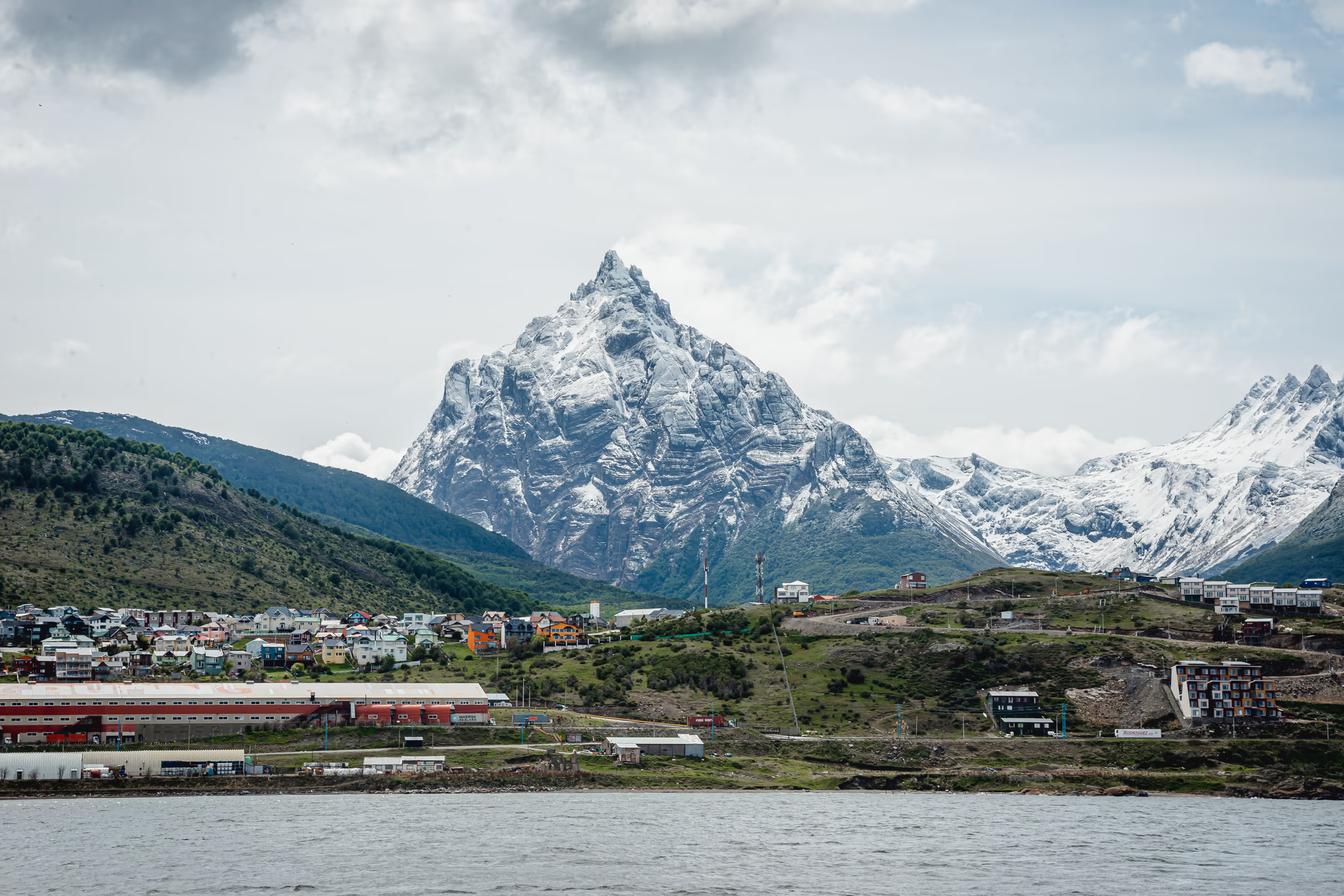
Tierra del Fuego · A city between mountains and sea
Ushuaia
Walk from the waterfront into the city's history, spend a day in the forest and come back to a warm table. The far south feels richer when Ushuaia is more than a place to board the next excursion.
Ushuaia puts a busy town in an extraordinary setting: a working harbour on the Beagle Channel, mountains above the streets and forest landscapes within reach of a day out. It can be tempting to book every hour into an excursion. Four or five nights allow a better balance, with a boat trip, a national-park day, a walk suited to the season and time to understand the city. Its histories include Indigenous communities, maritime travel, the penal colony and the growth of a modern regional capital. Keep an afternoon for the waterfront and a museum. Those hours make the landscape outside town more meaningful when you return to it.
01
Make the central waterfront your starting point
A walk along the shore reveals the port, the stranded Saint Christopher and the mountain skyline. Bahía Encerrada adds an urban nature reserve and another view back towards the city. Choose a loop that leaves time for a café or a museum.
02
Build a stay with room to change
Sea conditions can alter boat departures, while mountain weather affects walks. Schedule the outing that matters most early, and keep a less committed day later. A longer stay offers flexibility without requiring every day to become a bigger adventure.
03
Choose your season deliberately
Summer gives long daylight and more walking possibilities. Winter is a different trip, with snow activities, shorter days and different trail conditions. Autumn colour can be beautiful, but a warm-looking photograph says little about the temperature or footing.
Ushuaia · Inside the former prison
The waterfront and the former prison
Read the city from the inside.
The Museo Marítimo y del Presidio occupies the former prison complex, where the building itself is an essential part of the visit. Its galleries connect maritime history, Antarctic expeditions, art and the penal settlement. Leave enough time to understand the institution's role in the town rather than approach it only for a dramatic corridor photograph. The Museo del Fin del Mundo offers another perspective, with its Antigua Casa de Gobierno annex extending the visit. Along the waterfront, historic houses and the Paseo de los Antiguos Pobladores add further traces of the older town. Choose the interiors that interest you most; they do not all need to fit into one afternoon.
01
Look beyond the settlement narrative
The region's Yagán and Selk'nam histories precede the city. Cultural spaces such as Yatana connect local art and Indigenous heritage, offering another way to understand a place often introduced only through ships, prisoners and explorers.
02
Walk the waterfront between visits
Bahía Encerrada, the Saint Christopher and the working harbour show different sides of the city. The short distances can make an absorbing day when you stop to look, rather than use the shore solely as a route to a departure pier.
Near Ushuaia · Water and mountain scenery on the Laguna Esmeralda route
Valle Tierra Mayor and the national park
Let the forest set the pace.
A walk outside Ushuaia brings you into lenga woodland, wet ground and mountains that feel much closer than they did from the waterfront. The Laguna Esmeralda route, in the Valle Tierra Mayor reserve east of town, is a substantial popular outing: the official route is about nine kilometres return and takes around five hours. It crosses forest and peatland before reaching the lake, whose colour comes from glacial sediment. It is separate from Tierra del Fuego National Park, west of the city. Choose one for the day. The national park offers a different mix of lake, forest and coastal routes, including shorter options when a long mountain approach does not suit.
01
Match the walk to the conditions
Wet ground, mud, ice and snow change the effort and equipment needed. The signed trail does not make every season equivalent; choose a guide or a shorter open route when conditions exceed your experience.
02
Keep the return journey simple
Arrange transport to and from the actual trailhead, with enough daylight for the whole walk. A national-park tour, a train ride and an independent hike are different bookings and should not be treated as interchangeable ways to fill the same few hours.
At the seafood table · Cooked crab in close detail
The Beagle Channel and the evening table
Bring the coast into the meal.
The channel is part of Ushuaia's food identity as well as its view. Centolla, the southern king crab, is a familiar regional speciality, alongside other fish and shellfish on local menus. Ask how a dish is prepared and what is available, then choose the meal that appeals to you rather than order only to complete a destination checklist. A café after a cold walk can be just as welcome. For a more focused fishing-settlement visit, Puerto Almanza lies farther east along the Beagle coast. Give that journey and a booked meal their own time; it is a different experience from dinner within walking distance of your hotel.
01
Choose the preparation as well as the ingredient
A simple serving, a soup and a richer baked dish offer very different meals. Current menus and availability are more useful than an old restaurant list, particularly when a seasonal ingredient is the reason for going.
02
A boat trip gives the coastline context
Compare Beagle Channel excursions by their route, observation stops and any landing included. A lighthouse circuit and a longer seasonal penguin outing are different commitments. Keep the sailing separate from a tightly timed restaurant booking.
The city, water and mountains ask for different amounts of time. A good Ushuaia itinerary makes those differences work together.
01
Duration
Start with four or five nights.
That gives room for a city visit, a channel sailing, a park day and a walk, with some flexibility around the weather. Travellers focused on hiking or winter sports will benefit from longer. Two rushed days leave little room for a cancelled departure.
Keep the arrival afternoon close to town.
Put the highest-priority outing early in the stay.
02
Base
Choose convenience or a view knowingly.
Central accommodation puts meals, museums and many departure points nearby. Hillside properties may have memorable panoramas but add a climb, taxi ride or shuttle. Look at the actual address and transport arrangements before deciding that a distant view is worth the daily journey.
Check excursion pickup coverage.
Consider the return after dinner.
03
Transport
Book the journey to the activity.
An airport transfer, a park excursion and transport to a trailhead solve different problems. You do not need a rental car for every kind of stay, but independent outings require a reliable return arrangement. For the inland lakes, compare a day excursion with an overnight farther north. USH lists taxi and remis stands at the airport. Check whether an expedition booking includes the hotel or port transfer before arranging another vehicle; the airport-transfer guide explains the different handoffs.
Confirm where boats and walks start.
Keep a flight day free of long, weather-dependent outings.
04
Walking
Use the current trail information.
A popular walk can still involve exposed terrain or saturated peatland. Official descriptions give useful distance and difficulty, while current conditions determine whether the route suits you that day. Choose proper footwear and layers, and remain on the marked route to protect the fragile ground.
Use a guide when the conditions or route warrant it.
Do not treat the glacier beyond a lake as part of the ordinary walk.
05
Culture
Choose museums for different perspectives.
The former prison complex and the Museo del Fin del Mundo have different collections and settings. Give one a substantial visit before adding another. Check the current opening of smaller houses and cultural spaces; their value is in the interpretation, not simply the façade.
Make room for Indigenous histories and contemporary culture.
Use the waterfront as a connection between visits.
06
A wider route
Add the island before another airport.
Tolhuin and the lakes offer a quieter inland chapter. El Calafate and El Chaltén belong to another part of Patagonia, with transport and time required between them. Compare how many full days you gain in each place before adding one more flight.
Plan overland links through Chile as a separate travel leg.
Ushuaia is a departure point for Antarctic expedition voyages. Compare the ship, route, sailing days, landing arrangements and what weather can change before choosing dates. A port call is not proof of a bookable tourist departure. Start with Antarctica from Ushuaia and allow a separate arrival buffer before embarkation.
Useful visitor information
Plan with the latest local details.
Official and specialist information for the places in this guide.
Come back from the forest or the water, find a warm place to eat and leave time for one last look along the channel. The town is part of the southern journey, too.