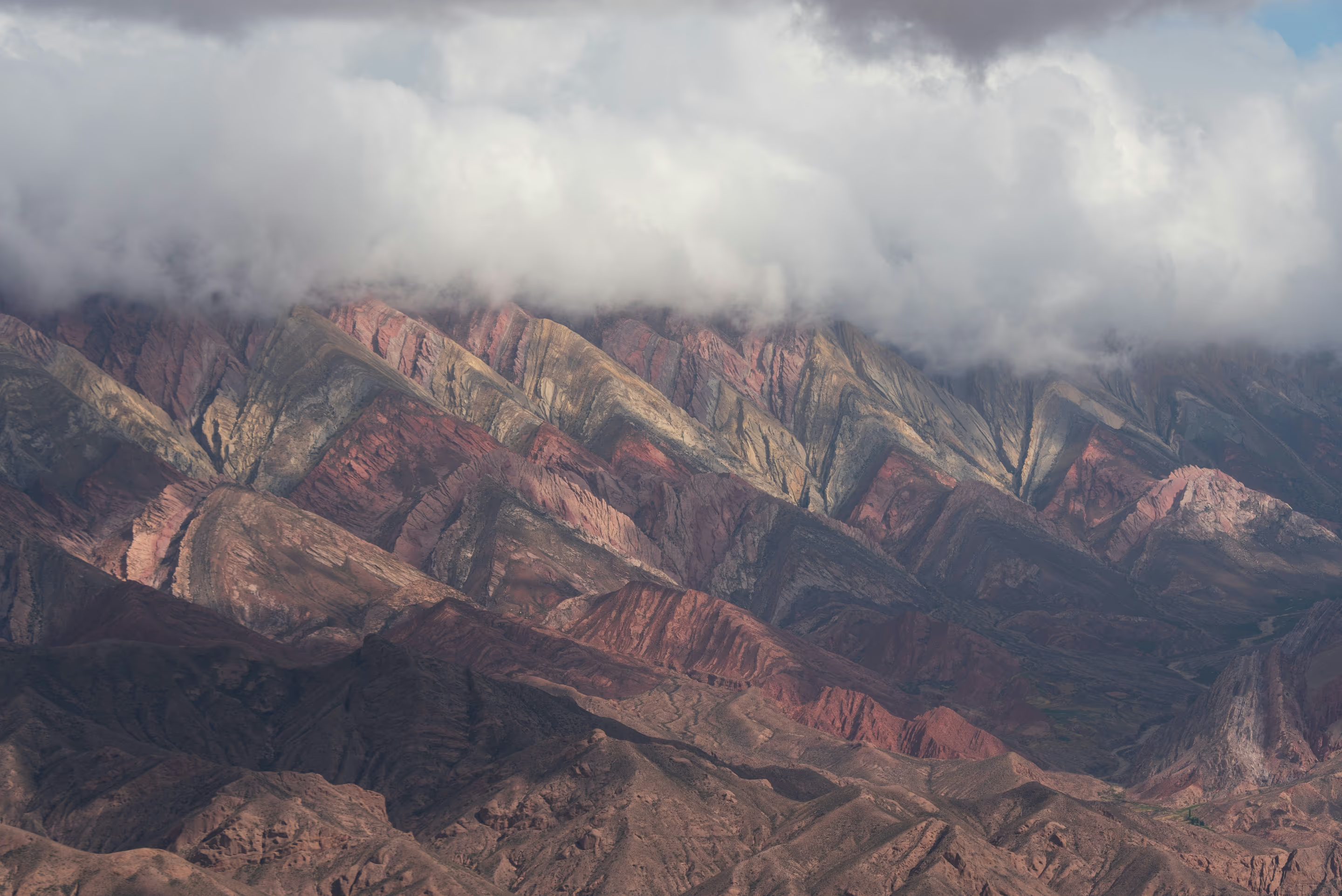
A Northwest journey
Salta and Jujuy, one thoughtful journey
Coloured hills, village streets and roads with their own rhythm. Give the Northwest's distinct valleys the time and attention they need.
The famous views are only the beginning. Connect Salta, the Quebrada and the Calchaquí Valleys through a route that respects their differences, their communities and the changes in elevation.
The Northwest is often sold through a handful of remarkable images: Purmamarca beneath coloured hills, the white expanse of Salinas Grandes, the folds of Hornocal and a road disappearing between red cliffs. They are compelling reasons to become interested. They are a poor substitute for understanding how the region fits together.
Salta and Jujuy contain several journeys rather than one continuous sightseeing circuit. The Quebrada de Humahuaca runs through a cultural landscape of settlements and mountain slopes. The road west towards the salt flats climbs into different country. South and southwest of Salta, the Calchaquí Valleys introduce another sequence of towns, vineyards and roads. These landscapes can be combined, but the combination needs time and a clear purpose.
The most rewarding route gives villages, museums, meals and ordinary evenings the same attention as viewpoints. It also treats elevation and road conditions as part of the choice from the beginning. You can leave the Northwest with a powerful sense of place without visiting every high lookout. Often, a more concentrated journey makes the landscape easier to understand and the days considerably more enjoyable.
Give each valley a separate place on the map
Begin by separating the Salta, Jujuy and Northwest region into the journeys that interest you. Salta city can be an urban starting point. North of it, San Salvador de Jujuy and the Quebrada de Humahuaca lead towards villages such as Purmamarca, Tilcara and Humahuaca. The salt-flat excursion branches west from the Purmamarca area rather than simply continuing along that valley.
Cachi and Cafayate belong to a different part of the regional map. They can form a Calchaquí Valleys journey, with the approaches and connecting roads becoming significant parts of the experience. The Quebrada de las Conchas is associated with the route towards Cafayate, while the approach to Cachi brings different terrain and protected landscapes into view.
This distinction immediately improves an itinerary. Instead of asking whether you can fit every named place into a week, ask which journeys deserve several days. A stay centred on the Quebrada may be enough for one trip. Another visitor may prefer Salta and the Calchaquí Valleys, especially if food, wine and changing road scenery are the main interests.
A combined route can work when you have sufficient time and a sensible order. It should not rely on the assumption that every road is fast, every high outing is suitable or every stop can be appreciated in the same short interval. Draw the actual route, identify where you will sleep and give the travel days their own place in the plan.
Salta: begin with a city, not just an arrival airport
Salta offers a useful introduction because it brings architecture, museums, food and music into the same urban setting. Treating it only as a place to collect a vehicle misses an opportunity to give the wider journey context. A city day can establish questions that make the valleys more interesting later.
Start around the central square and look at how the cathedral, arcades and surrounding streets organise the city. San Francisco's richly coloured façade provides another architectural focus. Rather than photographing each building and moving on, choose a short walk with time to look at entrances, materials and the way historic structures sit within current daily life.
Choose a museum according to the subject you want to understand. The MAAM introduces high-mountain archaeology, while the Museo Güemes and the Cabildo offer other historical directions. A visit involving human remains or sensitive cultural material may not suit everyone; look at the museum's own explanation before deciding. Interpretation should deepen the journey, not become an obligation to enter every important institution.
An evening at a peña can connect regional food with folkloric music. Ask what kind of programme is planned: a scheduled performance and a more informal musical gathering create different evenings. Empanadas, humitas and tamales can be part of the attraction without reducing the meal to a list of dishes you are expected to try.
Salta also helps you begin at a manageable pace. Arrival, a short walk, a meal and a proper night's rest can be a complete first day. There is no need to compensate for the flight by immediately adding a long excursion. The Northwest rewards attention, and that is easier to bring when the journey begins with some room to settle.
Jujuy's capital provides another useful perspective
San Salvador de Jujuy and its surroundings can introduce a different part of the region before you continue into the Quebrada. Plaza Belgrano, the cathedral and civic buildings offer an urban starting point, while the Xibi Xibi and greener surroundings provide a contrast with the drier landscapes farther north.
The capital's museums and interpretation of the National Flag of Civil Liberty can add historical context to a trip otherwise dominated by mountain scenery. Choose a compact visit that follows a subject you care about. The value is not in proving that you explored another city, but in giving the province a presence beyond the villages that appear most often in photographs.
Whether you stay here depends on your route and interests. An arrival arrangement may make it practical, or you may deliberately want a city interval before the valley. Do not choose solely because a map suggests that it is the obvious gateway. Consider what you would actually do with the time and how the next day's journey would work.
It can also be a useful reminder that Jujuy is not one unchanging landscape. Green valleys, urban life, the Quebrada and the higher plateau environments are different settings. Noticing those transitions gives the trip depth and helps explain why one packing list, one pace and one expectation of weather cannot describe every outing.
The Quebrada is a cultural route as well as a landscape
The Quebrada de Humahuaca is recognised by UNESCO for a cultural landscape shaped by a long history of movement and settlement. The Río Grande valley connects communities and contains evidence of different historical periods. That context matters because the villages are not simply convenient foregrounds for coloured mountains.
A thoughtful visit follows the relationship between the road, fields, settlements and slopes. Notice how a town occupies the available space, how paths lead towards the hills and how buildings relate to a square or church. You do not need to make every observation into an expert conclusion. Looking carefully is the beginning; interpretation can help explain what you notice.
Choose one or two bases that let you experience more than the busiest excursion hours. Waking in a village, returning after a walk and seeing the same streets in changing light can add more to the journey than another hotel change. Move when the new base meaningfully changes your access or daily rhythm, not because every town on the list must also become an overnight stay.
Living culture deserves care in how it is approached. A market, a religious event or a local celebration is not automatically a performance arranged for visitors. Ask before photographing people closely, follow local guidance and avoid assuming that a craft's appearance establishes its maker or origin. Conversations about material, use and production can be more valuable than collecting a familiar pattern.
The Quebrada can sustain several days even without high excursions. Village walks, archaeology, museums, food and the changing valley itself offer a substantial journey. That is useful to remember if weather, energy or altitude considerations make a famous lookout unsuitable. A changed plan need not become a diminished trip.
Purmamarca: give the familiar view a second look
Purmamarca is an understandable first choice for many travellers. The Cerro de los Siete Colores gives the village a striking setting, while the square, Santa Rosa de Lima church and surrounding streets bring the experience back to a human scale. The most satisfying visit connects those elements instead of treating the village as an entrance to a single viewpoint.
An overnight stay can change the encounter. You may see the hills before the main activity of the day, spend time around the square and return to a familiar street later. The light and the atmosphere will not necessarily match the photograph that inspired the visit, but the changing view is part of the reason to stay.
The Paseo de los Colorados offers another relationship with the landscape around the village. Check current access and terrain, then decide whether the walk suits your group and the conditions. A path through coloured country should be approached as an outing with its own needs, rather than assumed to be equivalent to a level stroll around the square.
The market adds colour of a different kind. Browse with curiosity and ask about the material and maker if you are considering a textile or other object. Do not assume everything on sale has the same provenance. A careful purchase can become a reminder of an actual conversation rather than simply another item associated with the destination.
Purmamarca can also be the starting area for a journey towards Salinas Grandes, but the village and the high road are separate experiences. Enjoying one does not oblige you to do the other. Make that decision according to the route, conditions and people travelling, rather than allowing proximity on the map to decide for you.
Tilcara: build a few days around interpretation and ordinary life
Tilcara can work well as a settled base because it combines archaeological interest with streets, food, music and access to the wider valley. Its appeal is not confined to one site. A stay becomes richer when you allow an outing and the return to town to form parts of the same day.
The Pucará is a particularly useful place to look with interpretation. The archaeological remains and the structures visible today also reflect later restoration and reconstruction. The University of Buenos Aires provides information about the site and current visits. Understanding that history helps avoid reading every standing wall as an untouched survival from the same period.
Take time to consider how the settlement occupied its hilltop position and how the spaces relate to one another. A guide or the site's interpretation can help connect the physical remains with past activities. The view matters, but it is not the only reason to be there. Archaeology becomes more compelling when people and practices remain in the picture.
The associated university museums and botanical interests can add another layer, depending on current access and your interests. You do not have to visit everything in one sequence. A substantial cultural stop followed by lunch and a quieter afternoon may produce a clearer memory than several institutions compressed into a morning.
Beyond town, outings such as the Garganta del Diablo area involve different terrain and access arrangements from the central streets. Ask locally about the route and conditions before deciding. A settled base gives you the flexibility to choose the suitable day rather than forcing an outdoor plan into the only available slot between hotel changes.
Humahuaca and Hornocal are separate decisions
Humahuaca and Hornocal often appear together in travel plans, but the town and the high viewpoint ask different things of a visitor. Humahuaca has streets, religious and civic heritage, shops and daily routines worth approaching on their own terms. Hornocal involves a mountain road and a substantially higher setting.
Give the town a cultural purpose beyond waiting for a departure. Walk the central area, look at the relationship between buildings and public space, and seek interpretation if you want to understand the local history more deeply. A meal or a pause in town helps keep the visit from becoming only a connection between vehicles.
Hornocal's folded colours can be extraordinary, but the outing should be deliberate. Assess the elevation, road conditions, weather and transport before deciding. A locally arranged trip may remove the responsibility of driving, but it does not remove the physical effects of going higher. A passenger and a driver reach the same elevated setting.
Visibility also belongs in the decision. A famous photograph does not guarantee a clear ridge or the same light on the day you arrive. Ask about current conditions and be prepared to change the plan. The value of a flexible itinerary is that it allows a sensible choice without making the rest of the journey feel as though it has failed.
Avoid combining several high outings simply because they are famous. One appropriate excursion with sufficient time and a comfortable return may be a better choice than consecutive days organised around the highest possible viewpoints. The town, the valley and the surrounding cultural landscape remain worthwhile when you decide to stay lower.
Salinas Grandes: the journey rises before the landscape opens
Salinas Grandes offers a dramatic contrast with the villages of the Quebrada: broad white ground, mineral texture and an open horizon. From the Purmamarca side, reaching it involves a road that climbs through mountain bends before entering higher country. That approach belongs in the decision just as much as the salt flat itself.
A flat surface at the destination does not mean the outing is physically equivalent to a low-elevation walk. Consider the full route and the highest country you will cross. Plan the day around current guidance, your readiness and the transport arrangement, with enough flexibility to turn back or change the visit if needed.
At the salt flats, use authorised visitor access and follow local guidance. The surface is part of a working and environmental landscape, not an unrestricted photographic playground. A local explanation can connect the striking appearance with the place's uses and communities, making the visit more substantial than a series of perspective photographs.
Dry texture and shallow reflective water produce very different images. Recent weather and conditions affect what you encounter, and reflections are not a reliable promise for a particular date. Choose the visit because the landscape interests you in more than one form. That leaves room to appreciate the actual scene rather than compare it constantly with an image on your phone.
The return deserves time as well. A long outing is less enjoyable when its final section is governed by a dinner reservation or another departure. Keep the day concentrated and allow the higher-country experience to stand on its own, without attaching several unrelated stops to justify the journey.
Make altitude part of the itinerary from the beginning
Elevation affects how a Northwest route should be arranged, even when the planned activities sound gentle. The height of the road, the destination and the place where you sleep are separate considerations. A low-effort viewpoint can still involve substantial altitude exposure, and physical fitness does not make someone immune to altitude illness.
The CDC's guidance emphasises gradual ascent and allowing time to acclimatise. Use that principle when choosing overnight stops and high outings, and seek individual medical advice where appropriate, particularly with relevant health conditions or previous altitude problems. A standard tour schedule is not evidence that the pace is suitable for every traveller.
If symptoms develop after ascent, do not keep going higher. Worsening symptoms, or serious signs such as breathlessness at rest, confusion or difficulty walking, require urgent medical help and descent when it can be done safely. The site's altitude and health guide connects this planning issue with authoritative information; it is more useful than relying on improvised remedies or reassurance from somebody else's experience.
Build alternatives before they are needed. A museum, a village day or a lower outing can preserve the purpose of the trip if a high excursion becomes unsuitable. Flexibility is much easier when the alternative is something you already want to do, rather than an empty day treated as a disappointment.
Cachi changes the shape of the journey
Cachi belongs to the Calchaquí Valleys side of the regional plan. Its low buildings, arcades, church and archaeological museum invite a different kind of visit from a rapid sequence of viewpoints. The town is best approached with time for its streets and the wider route that brings you there.
The journey from the Salta side through the Cuesta del Obispo and the country associated with Los Cardones National Park is part of the appeal. It also deserves its own realistic schedule. Mountain roads, authorised stops and changing conditions make this more than a simple distance calculation between two accommodation addresses.
In Cachi, begin near the square and let a cultural visit give the walk some direction. San José church and the archaeological museum offer different ways into the area's history. Then leave time for the smaller streets and a meal. An overnight stay is valuable when it allows this slower attention, not merely because a route map needs another marker.
If you plan to continue towards Cafayate along Ruta 40, investigate the current road surface and conditions for the actual section. Do not assume it will drive like the main approach to Cafayate from Salta. The connecting valley road can be a central experience of the trip, but it needs suitable transport, daylight and a willingness to travel at its pace.
You can choose Cachi without committing to the entire loop. A more concentrated journey may suit your time or confidence better. The useful question is whether the route between places is something you want to experience, not whether it creates the most elegant line on a map.
Cafayate brings wine into a larger cultural setting
Cafayate can provide a settled interval in a road-based journey. The square, cathedral, craftwork and surrounding wine country give the town interest between excursions. Its association with Torrontés offers a clear starting point for a tasting, but the visit need not be reduced to a sequence of winery appointments.
The Museo de la Vid y el Vino can supply context for the industry and its landscape. A museum visit followed by one thoughtful tasting may be more rewarding than several similar programmes. Ask about the particular wines, where the fruit was grown and what the producer wants the comparison to reveal.
Food and music can help connect the wine experience with the wider Northwest. Leave time for a meal that belongs to the evening rather than treating dinner as a short recovery stop after the road. A settled stay gives you the chance to notice how the town changes between the morning's departures and the later return.
Cafayate can work as part of a larger Calchaquí Valleys loop or as a more focused journey from Salta. Those are different itineraries with different transport demands. Choose the one that fits your time and interests, then protect the days in town from becoming a collection of obligations inherited from somebody else's route.
The Quebrada de las Conchas deserves more than a fast passage
The Quebrada de las Conchas makes the approach between Salta and Cafayate a destination in itself. Sculpted rock, changing colour and the shape of the valley create interest between the named formations. Give the road enough time to be seen from appropriate stopping places.
El Anfiteatro and Garganta del Diablo provide useful focal points, but they are distinct geological spaces. The latter should not be confused with the waterfall viewpoint of the same name at Iguazú. Look at the terrain and current visitor access before deciding how far to walk, and respect any boundaries that protect the formations or visitors.
This is a landscape in which light and cloud can change the experience without your travelling very far. A well-chosen pause can be more rewarding than adding another hurried stop. Keep to authorised access and avoid making unsafe roadside halts for a photograph, however tempting the view may be.
You can experience the route during a travel day or return to part of it from Cafayate. The better choice depends on how much luggage, driving and time pressure the arrival day already contains. A dedicated outing may offer more attention; a carefully planned arrival can also work when you keep the rest of the schedule light.
Count useful time at a base as carefully as the number of nights. Arriving late and leaving early can make an overnight stop little more than a place to sleep. Two nights usually create one intervening day, while the arrival and departure days still depend on the road and your other arrangements. Apply that distinction when comparing Purmamarca and Tilcara, or deciding whether Cachi deserves a longer stay. If a town's museum, walks and evening life are part of the reason to go, give them an actual place in the schedule. Otherwise, the accommodation changes may promise a deeper journey than the available hours can deliver.
Choose a complete journey, then leave something for later
For a trip focused on villages and cultural landscape, Salta with a settled Quebrada stay may be enough. Choose one or two bases, include interpretation and meals, and decide separately whether a high excursion fits. The result can feel complete without extending into every other part of the Northwest.
For a journey centred on road scenery and wine, Salta, Cachi and Cafayate may provide the stronger theme. Build it around the actual roads and overnight stops, with enough time for the towns rather than treating them as services between scenic sections. If the connecting route is unsuitable, a more focused arrangement remains a valid choice.
A longer combined trip should preserve the distinct character of both journeys. Use a city interval or a lighter day to separate demanding travel sections. Resist the temptation to fill every apparent gap with another excursion; a pause can make the next landscape more vivid by giving you time to absorb the previous one.
The Northwest is memorable because its landscapes and communities remain in conversation. Let a church, a market, a museum, a vineyard and a mountain road each contribute something different. The best route is the one that leaves you able to remember those differences, rather than a long list of places seen briefly through the same window.


