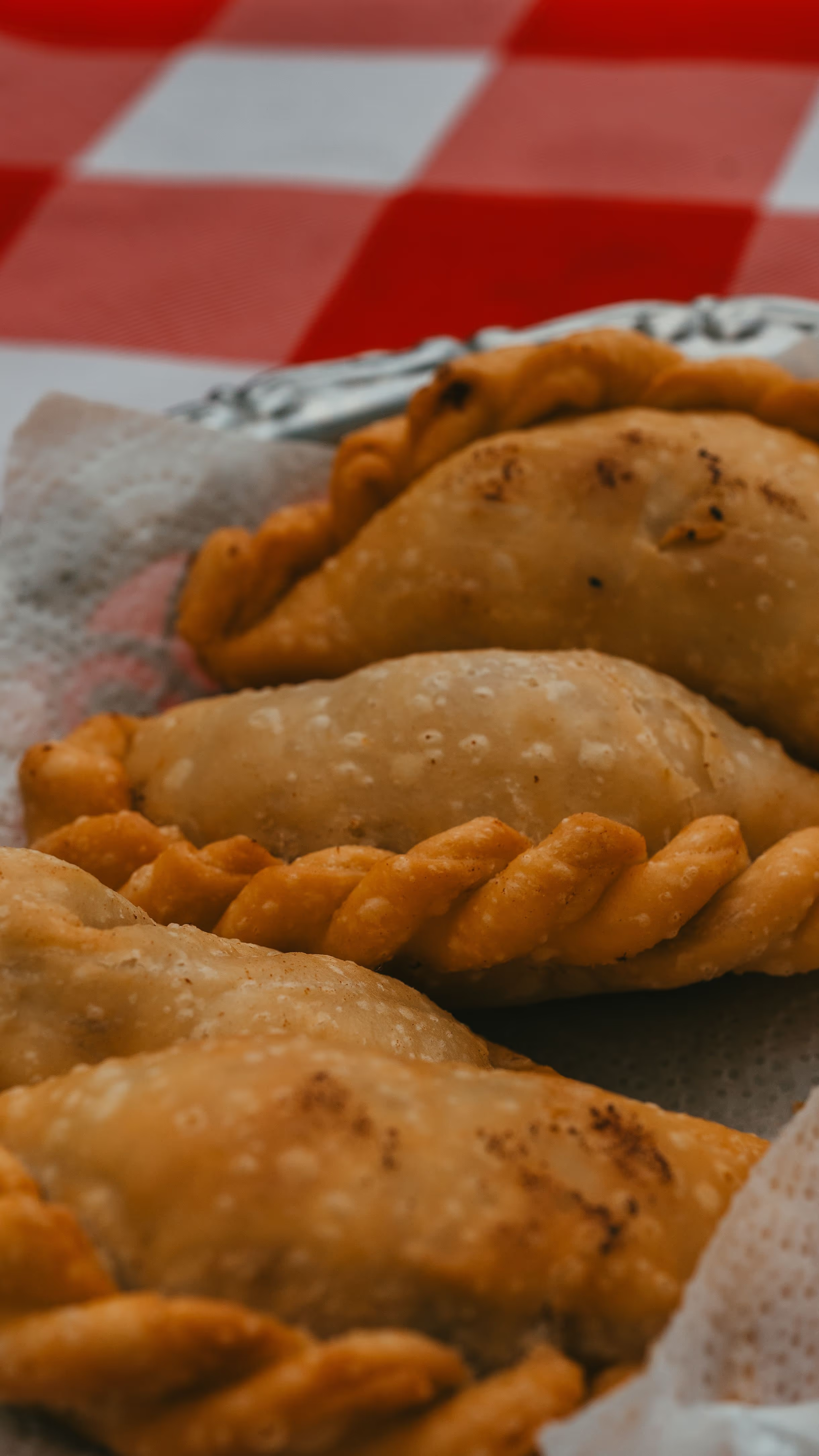
A country inside a folded pastry
Argentina, told through its empanadas
Follow empanadas through Argentina's regions, noticing dough, filling and technique without reducing each province to a single recipe.
A folded edge, a first careful bite, a sauce you have not tasted before. Empanadas offer a small, delicious way to notice a changing country.
An empanada looks like a compact answer to hunger: folded dough, a sealed edge, something savoury inside. Then the questions begin. Is the beef chopped or minced? Is that potato in the filling? Does the sauce belong inside the first bite or alongside it? Why does this one taste different from the one bought a few streets away?
Those small differences make empanadas a rewarding companion to travel in Argentina. They give you something concrete to notice as the landscape changes, without requiring a formal tasting or an expensive reservation. A lunch counter can introduce an ingredient, a technique or a family preference that a broad regional label leaves out.
The pleasure is in the comparison, not in appointing one winner for the country. Provincial identities matter, and cooks take pride in them. So do household variations, neighbourhood habits and the practical choices of the person making today's batch. Come with curiosity and appetite; leave enough room for the next version to surprise you.
Begin with the dough, not the map
Before deciding what makes an empanada regional, pay attention to what holds it together. The dough has to contain the filling, seal securely and cook into something worth eating in its own right. An attractive fold cannot rescue a heavy or unappealing wrapper.
Notice the edge and the centre separately. The sealed rim is thicker than the body and may have a different texture. The surface can be crisp, blistered, browned or softer according to the dough and method. None of those appearances alone proves where it was made.
Oven and fryer tell different stories
Al horno means baked; frita means fried. Both belong within Argentina's empanada traditions. Fried does not automatically mean an inferior shortcut, and an oven does not automatically confer authenticity.
The difference is immediate in the mouth. Consider how the wrapper breaks, how it holds the juices and how it feels beside the filling. A baked version with dark patches and a fried version with a delicately crisp surface offer different pleasures.
Ask which method the house recommends. Some places specialise; others offer a choice. If you are comparing fillings, keeping the cooking method the same can make the differences easier to recognise. On another day, ordering the same filling in two preparations can be the more interesting experiment.
The repulgue is useful, but it is not a universal alphabet
The folded seal is called the repulgue. It can be practical, decorative and a source of pride. Shops may use different closures or markings to distinguish fillings, but their system is their own.
Ask for the key when a mixed order arrives. A printed mark, a folded shape or a position in the box may identify the contents. Guessing becomes less charming when somebody avoids a particular ingredient.
Stories about the correct number of folds are part of empanada culture too. They should be heard as local traditions rather than treated as a passport inspection for every pastry. The person making the food can explain what the detail means in that kitchen.

Salta: learn to notice the small things
In Salta, an empanada lunch offers an accessible introduction to the region's cooking. The familiar salteña style often combines chopped beef with potato, egg and seasoning in a relatively small pastry. That description is a starting point, not a promise that every cook uses an identical formula.
The size encourages comparison, but it can also encourage ordering too much too quickly. Begin with a modest selection and see how the kitchen's version eats. A small pastry can still be rich, particularly when several arrive hot together.
Look at the filling after the first bite
Notice whether the meat comes in distinct small pieces, how the potato sits among them and how much moisture remains. The pleasure depends on the relationship between those elements. More meat is not the only possible measure of a well-made filling.
Seasoning is another conversation. Cumin, paprika and chilli can contribute differently, while a sauce served alongside changes the bite again. Try a little of the empanada before adding anything so that you can understand the cook's starting point.
If you want to ask one useful question, make it about this version: what goes into it, or what the house considers distinctive. That invites an answer grounded in the food in front of you rather than a debate about who owns the only authentic recipe.
For a concrete city setting, the municipality’s Patio de la Empanada introduction places the food courtyard at Avenida San Martín and Islas Malvinas. It describes a collection of food stalls with knife-cut beef empanadas alongside fillings such as chicken, cheese and charqui, plus dishes including humitas, tamales and locro. That makes it a useful example of the wider meal surrounding the best-known pastry.
Think of the courtyard as several kitchens to look at, rather than one standardised tasting menu. Read the current stall offerings before choosing where to sit. A beef empanada followed by a shared corn-based dish would let you compare two forms of northern cooking in one meal; a mixed pastry order would keep the attention on dough and filling. Those are possible ways to approach the selection, not fixed packages sold by the courtyard. Confirm the particular stall’s service and available dishes on the day.
Give the city meal its own time
Salta is an excellent place to let lunch interrupt sightseeing. A simple meal followed by another stretch of older streets or a museum can produce a more satisfying day than treating food as something to collect between departures.
Do not assume that a peña evening and a quick empanada lunch are the same experience. Music, seating, reservations and the length of the evening all change the occasion. Choose one because it fits the kind of day you want.
A busy local room can be appealing, but busyness alone does not answer every question. Look at the menu and service, explain dietary needs and choose a place where you feel comfortable settling in.
The valleys reveal why a province is not one recipe
Leaving the city for the Calchaquí Valleys changes the setting without placing you outside Salta's food culture. That is a useful reminder that a provincial name covers several landscapes and communities.
The province's own culinary mapping records a far broader repertoire than the familiar beef empanada alone, including preparations associated with particular towns and highland ingredients. A traveller should not expect every dish everywhere. The interesting question is what the kitchen you have reached actually makes.
In Cachi, give a meal time among the town's streets and ask what the kitchen has that day. In Cafayate, compare a town empanadería with a winery lunch: they offer different settings, and neither represents every valley kitchen. Decide how much to order by what follows, whether another regional dish or a wine-paired meal.
Tucumán: the filling has its own craft
Tucumán's official recipe foregrounds knife-cut matambre, onion, hard-boiled egg and spring onion. Its preparation also uses cooking broth, helping explain the juicy character associated with the style. That is a specific culinary tradition, with work in the filling as well as in the fold.
Famaillá's National Empanada Festival gives public recognition to the people who make them. The celebration matters as community culture, not merely as a convenient claim that one town has solved the question of the country's best lunch.
The recipe’s sequence explains more than an ingredient list. The matambre is cooked first, cooled and then cut into small pieces. Onion is softened separately before the meat, broth and seasonings are brought together; egg and spring onion join the filling before it cools. “Knife-cut” therefore describes a deliberate stage of preparation, rather than a promise that raw steak was simply enclosed in pastry.
The dough has a connection to that filling too: the published recipe combines flour and beef fat with broth from cooking the meat. The same cooking liquid contributes to both parts of the empanada. That is a useful detail to notice when the pastry itself tastes savoury, rather than serving only as a container. These steps describe Tucumán’s published version, not a rule that every household must follow. They make the maker’s work easier to appreciate: the broth, the cutting, the cooling and the seal each have a place before the finished pastry reaches the table.
Juiciness is part of the design
With a juicy empanada, the first bite deserves a little care. Hold it over your plate and let the heat settle enough to enjoy the filling. Rushing the hottest mouthful tells you very little about its flavour.
Look for the balance between chopped meat, onion and pastry. A filling can be moist without feeling like an accident contained by dough. The wrapper and seal have a practical role in keeping the meal together.
This also explains why an empanada eaten promptly may make a different impression from one kept in a closed takeaway box. Steam and time change texture. Compare like with like before deciding that one town's cooking is better than another's.
A festival is an occasion, not a permanent opening schedule
If a food celebration motivates your trip, confirm the current dates and programme with the organiser. An annual tradition does not mean the same event arrangement or visitor experience every year.
You can also enjoy the food outside festival time. A normal lunch may offer more opportunity to ask a question or notice the cooking than a crowded event. The two experiences serve different interests.
There is no need to add a long detour solely to complete a checklist of famous empanadas. If Tucumán belongs naturally in your route, give its food attention. If it does not, leave the comparison open for another journey.

Jujuy: the sauce changes the conversation
Jujuy brings another useful comparison. San Salvador de Jujuy's tourism information highlights fried beef empanadas with yasgua, a spicy sauce made with tomato and locoto chilli. The accompaniment is part of what makes the plate distinctive.
Taste the sauce before deciding how much to add. Heat varies between preparations and personal expectations. Asking for it on the side leaves you free to explore the combination at your own pace.
The capital and the highlands are different settings
A meal in the provincial capital belongs to a living city with its own routines. Travelling into the Quebrada de Humahuaca brings different settlements, landscapes and opportunities to encounter regional ingredients.
Do not use a single dish to flatten those distinctions. Ask about a named filling instead of assuming that everything sold in the highlands contains llama, quinoa or another ingredient associated with the region.
Regional menus can include familiar beef and cheese alongside other preparations. That mixture is not a failure of authenticity. People eat a wider range of food than the handful of dishes used to introduce their region to visitors.
A meal around Humahuaca
Around Humahuaca and Hornocal, a town meal can give a scenic day a human centre. Leave time to sit, eat and look at more than the next viewpoint on the schedule.
If the menu offers something unfamiliar, ask what it is and how it is prepared. A clear answer is more useful than choosing solely because the ingredient sounds remote or unusual.
The same courtesy applies when photographing food preparation. Ask before turning a working kitchen or stall into a visual record. Buying lunch supports the business; respectful interest can make the encounter more rewarding for everyone.
Beyond the northern traditions: ask about the kitchen's version
A province name is not a universal recipe. Menus change, recipes travel and families disagree; ask what the kitchen's empanada contains and whether it is baked or fried. The label alone cannot settle an ingredient question.
In Mendoza, compare a town meal with the fuller sequence of a winery lunch. In Córdoba, use the destination guide to place lunch among the city's other interests. Choose the meal for the occasion, without assuming either province has one standard filling.

Buenos Aires gathers the conversation
In Buenos Aires, regional names can appear next to one another on a menu. The capital lets you compare styles without travelling between every province, but a city shop's version still represents that particular kitchen.
Read the description rather than relying only on the label. A “salteña” or “tucumana” gives an indication of intended style; it does not remove the need to ask about ingredients when they matter.
A mixed order needs a little organisation
A dozen assorted empanadas sounds simple until nobody knows which is which. Ask how the shop marks the fillings, and keep the explanation with the food.
For a group, choose the proportions deliberately. One person may want to compare beef preparations while another prefers cheese or vegetables. An assortment selected at random can leave everybody with one favourite and several pieces they did not want.
Ordering a smaller first round can help in a sit-down setting. With takeaway, think about when and where you will eat it. The best comparison is made while the food is in the condition the kitchen intended, not after an afternoon spent carrying a box around.
Do not mistake convenience for insignificance
An empanada bought for an ordinary lunch is still worth attention. Its role in daily eating is part of its appeal. It does not need a tasting menu, a chef's speech or a dramatic origin story to be memorable.
Equally, a more elaborate interpretation can be interesting on its own terms. The question is whether the result tastes good and whether the description is honest about what the kitchen is doing.
The city makes both possibilities available. Leave room for a practical meal as well as a planned restaurant experience, and let each be good at its own job.
When the menu offers more than empanadas
Following one food across a country is enjoyable, but the neighbouring dishes can explain what makes it distinctive. In the Northwest, humitas and tamales provide a particularly useful comparison: other carefully assembled foods, with different ingredients, textures and wrappers.
Humita is not simply another folded pastry
A humita can arrive in a corn husk or served on a plate. Tucumán's published preparation centres on fresh corn and squash, with cheese among the ingredients. Its soft texture gives a different expression of regional cooking from a wheat-dough empanada.
If a menu also lists an empanada de humita, ask how that filling is made. The shared word points towards corn, but the finished dishes are not identical. Understanding the format helps you order the experience you actually want.
One of each, shared, can reveal more than several similar beef fillings. You notice what the wrapper does, how the main ingredient changes the texture and why the accompaniment that suits one dish may be unnecessary on another.
The province’s humita recipe also shows why the texture differs. Grated fresh corn is cooked with softened onion and peppers, then combined with squash purée; the mixture is stirred until dense before it is cooled for wrapping. A piece of creamy cheese is placed between layers of that corn mixture. The husks are softened, crossed and tied around the parcel, which is heated in water for serving.
These details give you something specific to notice when it is opened: the corn forms the body of the dish, while the cheese provides a separate centre. The preparation is already moist before it enters its wrapper, unlike a pastry whose exposed surface browns in an oven. A humita served on a plate can emphasise the soft mixture without the parcel-opening moment. Neither format needs to imitate the crisp edge of an empanada to be successful.
A tamal has a different construction
Tucumán's official tamal preparation uses a cornmeal mixture with squash around a meat filling, wrapped in corn husks. That is a different structure from meat enclosed in pastry, even though both foods involve filling and careful assembly.
The husk is a wrapper to open. Take a moment to see how the contents are arranged before beginning to eat. The distinction becomes much clearer at the table than in a hurried English menu translation that calls several different dishes a kind of dumpling.
Trying these foods together should remain a meal, not a demand to consume the entire regional repertoire. Share where sensible, and leave a favourite for another day.
The published tamal method starts from fine cornmeal rather than grated fresh corn. It is cooked with the meat’s broth into a thick, workable paste and mixed with squash. The filling is prepared separately: diced cooked beef joins onion softened in fat with paprika, followed by raisins and chopped hard-boiled egg. Layers of the corn paste surround that filling inside softened husks, which are tied closed before cooking in water.
That layered structure is the useful comparison with the humita beside it. You can distinguish the surrounding corn mixture from the seasoned meat at the centre, rather than expecting one uniform filling. The raisins in this particular recipe also introduce sweetness into a savoury dish; ask about the kitchen’s version if that combination interests you. A published regional recipe offers a clear example of technique, while the actual plate can still reflect another family’s preference. The comparison becomes about construction and flavour rather than deciding which wrapper is more authentic.
Tradition also includes new choices
A city kitchen might offer an empanada with a filling far beyond the familiar regional examples. Argentina's national tourism coverage includes contemporary interpretations as well as established styles, reflecting a food culture that continues to develop.
Treat the description honestly. A creative filling does not need to be presented as an ancient provincial rule to be worthwhile. Equally, a classic beef empanada does not need an unusual ingredient to justify its place.
That distinction makes room for both continuity and invention. You can value the cook preserving a family preparation and the cook trying something different, while asking the same basic question of each: is this a thoughtful, enjoyable thing to eat?
How to compare without turning lunch into an exam
A little structure can sharpen your attention. Too much can make a friendly meal feel like a judging panel. Choose one or two things to notice, then return to enjoying the food and company.
Change one thing at a time
If two places make baked beef empanadas, that is a useful starting comparison. You can notice the pastry, filling and seasoning without simultaneously changing every element.
On another occasion, compare baked and fried versions from one kitchen. Or taste one with and without its accompanying sauce. These small experiments are easier to understand than a table of unrelated fillings eaten in rapid succession.
Keep expectations flexible. A favourite discovered in one town need not become the standard every later cook must imitate. Difference is the reason to continue tasting.
Use ordinary language
You do not need specialist tasting vocabulary. Crisp, tender, juicy, dry, sweet, peppery or strongly seasoned can describe what you notice. Be precise enough that your companion understands which part you mean.
Distinguish preference from a fault. Disliking raisins is a preference; an order arriving with an ingredient the restaurant said it did not contain is a different problem. Keeping those categories separate makes you a fairer diner.
If you make notes, record the place and the version rather than a sweeping verdict about the province. A small accurate memory is more useful than a grand conclusion drawn from one lunch.
Order thoughtfully for the people at the table
The folded shape hides ingredients. That makes a direct conversation especially useful when somebody has a dietary requirement or a strong dislike.
The filling is only part of the answer
A vegetable or cheese filling does not tell you what fat is used in the dough or how the food is prepared. Ask about the complete empanada, including accompaniments, when that distinction matters.
For allergies or coeliac requirements, explain the need clearly and ask the kitchen about its actual preparation arrangements. Do not treat a flavour name, a handwritten sign or a visual inspection as a complete answer.
A mixed group can still enjoy the meal when the choice is made thoughtfully. Find a place with suitable options before everybody is hungry, and keep special orders identifiable when the food arrives.
Let the meal have a sensible size
There is no fixed number of empanadas that makes a lunch. Sizes, richness and appetites vary. Ask how the restaurant describes its portions and consider whether other dishes are coming.
For children or cautious eaters, a familiar filling alongside one shared new taste may work better than a plate entirely devoted to experimentation. Curiosity develops more easily without pressure.
The same applies to adults. Nobody owes a travelling companion enthusiasm for every ingredient. A good shared meal gives people room to find what they enjoy.
Remember the hands behind the fold
It is easy to admire an empanada as a neat object and overlook the labour in it: preparing the filling, making or handling the dough, portioning, sealing and cooking. A small pastry can contain a great deal of repeated work.
When a cook has time to answer, asking about one of those steps can be more rewarding than asking for the secret of the “best” empanada. The question recognises a craft without demanding a performance.
Respect a busy service. Sometimes the appropriate response is simply to order, pay and enjoy the food. A warm exchange does not have to become an interview to count as a worthwhile encounter.
The regional journey remains open-ended. You may remember Salta for a particular filling, Jujuy for the sauce, Tucumán for its juicy matambre tradition or Buenos Aires for the everyday pleasure of a well-chosen box.
What connects those memories is attention to the actual meal. The map gives you a starting point. The cook, the dough and the first careful bite tell you what happens next.
A few questions worth carrying
- How is this one cooked? Baked and fried versions offer different textures.
- What is in the filling and dough? A regional name is a useful clue, not a complete recipe.
- How are the flavours marked? Keep the answer with an assorted order.
- What would you recommend today? Ask about the kitchen's own strengths.
- What else belongs on this table? Let the empanada introduce a wider food culture.


