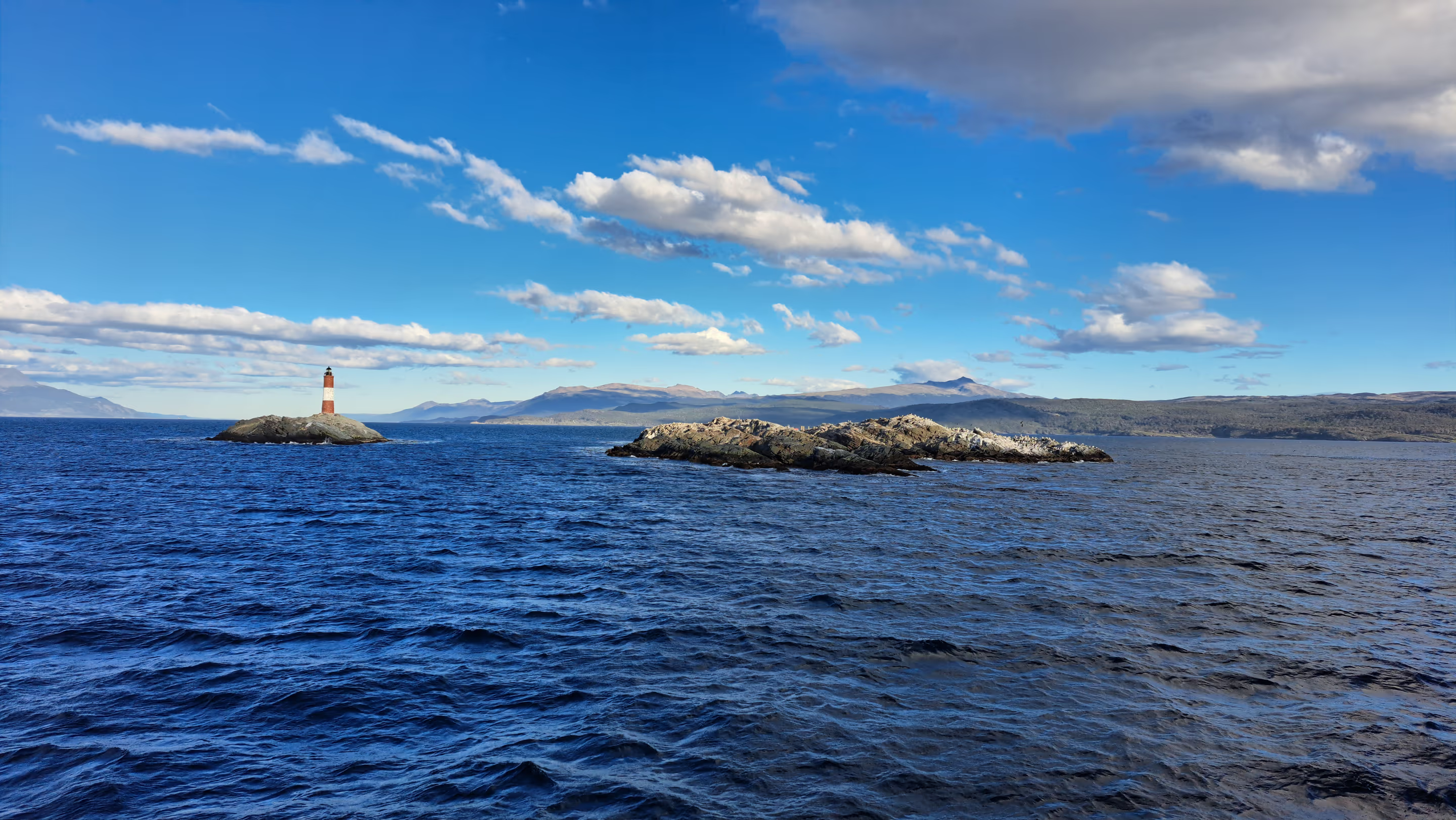
Sea, forest and the far south
When the journey to Ushuaia earns its place
Decide whether Ushuaia belongs in your Argentina trip by comparing its channel, forest and island history with the days you would give up elsewhere.
Beyond the end-of-the-world slogan lies a meeting of sea, forest and human stories. Come south for the days you want to have there.
There are places people book because of what they want to do, and places they book because of where they are. Ushuaia often begins in the second category. The name promises a southern limit, a harbour below mountains and the feeling of reaching the end of something. That is a powerful invitation. It is also an incomplete reason to spend several days and another pair of flights.
The better argument emerges when you look beyond the map's edge. Here, forest reaches salt water. A working port faces the Beagle Channel. The story of the island moves between Indigenous life, maritime journeys, a penal colony and the modern city. A walk beside a sheltered bay and a boat crossing can reveal different sides of the same landscape.
The question is whether those experiences belong in your particular Argentina journey. Adding Ushuaia can make a trip richer. It can also take away the settled days that would have made another region memorable. Before booking, imagine the stay without the phrase end of the world. If the channel, forest and island history still draw you, there is something substantial to build around.
What changes when the mountains meet the sea
Much of the familiar image of Patagonia is continental: a road beneath a huge sky, an isolated mountain wall, a glacier at the far end of a lake. Southern Tierra del Fuego offers a different relationship between land and water. The channel is part of the daily view, while wooded slopes rise behind the city.
That combination matters more than winning a contest between scenic places. A traveller who has already spent several days looking at lakes and mountains can find a new perspective here by going onto salt water, noticing coastal birds and exploring the human history of navigation. Someone who simply books another mountain viewpoint may experience less of the difference.
A port with a life beyond the visitor
Ushuaia is a functioning city rather than a wilderness lodge stretched along a waterfront. Traffic, shops, housing and port activity sit close to the scenery. The mountains do not make those ordinary urban details disappear, and expecting an uninterrupted picturesque village is likely to misread the place.
Approach it as a port. Watch how the bay organises the town, how the streets climb away from it and how the weather changes the view across the water. The juxtaposition of practical buildings and dramatic geography is part of its character. A hotel photograph that removes the town entirely may describe a room's view more accurately than the experience of staying here.
This also affects where to sleep. A central address makes meals and the waterfront easier to reach on foot. A property above town or farther along the coast may offer a broader view but require arranged transport. Steep streets, steps and wind can make a modest map distance feel quite different after an excursion.
The scale of a useful first stay
For most first visits, three or four nights provide a more convincing introduction than a single hurried stop. That is an editorial starting point, not a promise that every traveller needs the same number. The important quantity is the number of usable days between arrival and departure.
With two full days, choose a channel outing and a national-park day, leaving the city to the margins. A third full day gives you room for a different interest: island history, a walk outside the park, or the road towards the lakes. It also creates some flexibility if conditions change.
Count excursions by their actual content. Two boat outings may be justified if one concentrates on a nearby island and another reaches a different landscape. They may be redundant if both mainly repeat the same channel circuit. More nights help when they buy different experiences, not simply a longer list of bookings.
The Beagle Channel: choose what happens after boarding
A boat journey is one of the clearest reasons to include Ushuaia. From the water, the city becomes a strip between the harbour and the mountains; farther out, islands and coastlines become the centre of attention. The experience can feel very different from another road trip through Patagonia.
But “Beagle Channel cruise” is a broad description. The Beagle Channel guide separates the main choices. For booking purposes, establish the route, whether anyone goes ashore, the time on land and how you return. Those details tell you more than the photograph of a boat beneath a mountain.
A shorter navigation or a longer excursion?
A shorter circuit can introduce the channel's island scenery, birds and sea lions while leaving part of the day for town. It suits a visitor who wants time on the water without making the whole stay revolve around one excursion. Compare vessels and deck access as well as duration.
A longer journey towards the eastern channel may include Isla Martillo, Harberton or a road connection. That changes the day considerably. The attraction is not merely travelling farther: it is reaching a different place or spending time with a subject that interests you.
Do not assume that a penguin-colony stop means walking ashore. Some visits observe from the vessel; authorised landing arrangements are a separate proposition. Ask exactly what the booked product includes, particularly if being on land near the colony is the reason you are choosing it.
Wildlife belongs to the route and the season
Sea lions on a rocky island, cormorants along a shoreline and penguins at a seasonal colony are different wildlife experiences. They involve different habitats and expectations. A brochure montage can make them appear to be one reliably available encounter.
Choose the principal experience first, then check whether your dates and route support it. Avoid making an entire journey depend on an unconfirmed animal sighting. A worthwhile channel excursion should still offer an interesting landscape, informed interpretation and a satisfying day on the water.
The boat itself matters. Consider how your group handles wind, motion, exposed decks and boarding steps. Ask the operator about the actual vessel and access arrangements. A smaller boat is not automatically better, and a larger vessel is not automatically comfortable for every passenger in every sea.
Read the shore as well as the skyline
It is easy to spend the whole navigation looking at distant mountains. The closer landscape can be just as revealing: the shape of an island, the meeting of trees and shoreline, the pattern of birds along rocks. A guide who helps you notice those relationships adds more than a stream of place names.
Put the camera away occasionally. A moving vessel makes a poor platform for trying to control every composition. Watching a bird move between water and air, or seeing a headland gradually change shape, lets the journey remain an experience rather than an extended attempt to reproduce a brochure image.
The national park rewards a day with a shape
Tierra del Fuego National Park brings forest, lakes, peatlands and marine shoreline together. This is the second strong reason to visit the far south: several environments meet within a landscape that can be explored at different levels of effort.
A first visit need not be a major trek. It does need a better idea than reaching the road-end sign and immediately leaving. Select one main walk or sequence of shorter places, make room to stop, and arrange transport around what you intend to do.
A coastal day and a mountain day are different plans
The park offers short paths around places such as Lapataia as well as longer routes through coastal and upland terrain. The Costera route, for example, belongs to the shore-and-forest experience; Cerro Guanaco is a more demanding mountain undertaking. They should not be treated as interchangeable items on a sightseeing list.
Official descriptions of distances and seasonal access can change, and different visitor pages do not always present measurements in the same way. Use the park's current information for your exact route rather than relying on a copied number. The local guide linked above is the starting point for selecting the kind of day.
A sensible booking question is: how much time will we actually spend outside the vehicle? A tour with several brief stops may suit someone seeking an overview. A person who wants to sit by the water or walk slowly through forest needs a programme that leaves room for that.
Small details make the forest interesting
The park's trees are not a uniform green backdrop. Lenga, guindo and ñire contribute to different parts of the woodland, while peatlands bring a contrasting texture to the ground. In autumn, deciduous foliage changes the appearance of the landscape; at other times, bark, moss and the structure of the canopy deserve attention.
You do not need botanical expertise to enjoy those distinctions. Notice where the forest becomes denser, where it opens towards water and where the ground changes beneath the path. An interpretive stop can give names to differences you have already begun to see.
Stay on the established route through sensitive ground. A tempting shortcut across wet vegetation can leave damage well beyond a single footprint. The practical reward is also straightforward: a marked path usually gives a better experience than an improvised struggle to keep shoes dry.
The shore has a human history
The park protects cultural evidence as well as scenery. Shell deposits and other archaeological traces record earlier human activity along the channel, while later remains relate to timber extraction and settlement. These are reasons to resist describing the landscape as a place nobody touched before tourism arrived.
Read interpretation carefully and leave material where it lies. A shell accumulation is not an invitation to collect souvenirs. A name in an Indigenous language is more than atmosphere for a visitor brochure.
The most useful cultural interpretation connects past and present rather than confining Indigenous peoples to a vanished world. Give that subject time in town as well as in the park. It changes the meaning of the coast you have come to see.
Make room for the island's stories
A trip to Ushuaia becomes more distinctive when its museums are part of the plan. They provide a different kind of attention after a boat trip or a long walk, and they help explain why the modern city occupies this particular place.
The Museo del Fin del Mundo occupies historic buildings, including a former bank and the old government house. The Maritime Museum and former prison offer another set of subjects. These are complementary perspectives, not simply two indoor substitutes for a cancelled excursion.
Look beyond the prison narrative
The penal history is striking, and it can easily dominate the way visitors understand Ushuaia. It should sit within a wider account of the island: Indigenous cultures, maritime connections, changing economies and everyday community life.
Choose a museum visit for the questions it raises. How did people travel? What knowledge made life here possible? How were the shore and forest used? What survives in buildings, objects and place names? Those questions lead to a richer day than treating the galleries as a sequence of curiosities.
Avoid trying to complete every museum in one afternoon. One considered visit, followed by a walk that helps you locate the story in the town, can be more memorable than moving rapidly through several collections.
Harberton adds a different shore
A visit to Harberton can connect a channel journey with the history of a longstanding estancia and the natural-history work associated with the Acatushún museum. It is most worthwhile when those subjects interest you, rather than as an extra name included because a package happens to stop there.
The estate's visitor arrangements are seasonal. Establish what is open, which guided visit is included and how much time remains on site. A combined boat-and-road programme and a dedicated visit can produce quite different impressions.
Harberton also illustrates why access questions should be specific. Its own visitor information flags limitations for people with reduced mobility. Ask about the actual ground, steps and route before assuming that an organised excursion solves every access need.
The road inland: Escondido, Fagnano and Tolhuin
Heading away from Ushuaia introduces another Tierra del Fuego. The relationship to the channel gives way to an inland journey through mountains, forest and large lakes. Tolhuin and Lago Fagnano are a reason to extend a visit when you want to understand the island beyond its southern port.
The road is not an automatic addition to every short stay. It takes a day that could otherwise belong to the national park, town or a longer walk. Include it because a lake-and-forest journey appeals, not because it appears under “must see” in a list.
A viewpoint or a place to spend time?
The Lago Escondido view and the approach to Fagnano can make a satisfying excursion. The question is what happens between photographs. Some programmes emphasise driving; others allow time at a shore, a walk or a meal. Read the sequence closely.
Tolhuin adds a town and its local history to the journey. The Museo Kami, in a former police building, gives the area a human context. Local interpretation and craft traditions offer another way into the island besides its landscape.
A longer stay near Fagnano changes the experience again. A lake that appears briefly from a viewpoint becomes the setting for the morning and evening. That can be appealing on a return visit, especially for someone who no longer needs to spend every day departing from Ushuaia.
Leave the whole island for a longer journey
Tierra del Fuego extends far beyond the visitor circuit around Ushuaia. Reaching farther parts of the island introduces different roads, settlements and practical arrangements. A few available hours are not sufficient reason to keep extending the route.
For a first visit, it is reasonable to stop with a thoughtful introduction to the south. For a later journey, the island can become the main subject rather than an appendix to mainland Patagonia. These are both valid trips, but they ask for different amounts of time and preparation.
Walking outside the park needs its own decision
Laguna Esmeralda is one of the area's familiar images: a mountain lake reached through a landscape of forest and wet ground. Its popularity does not make the approach a casual urban stroll. Conditions, equipment and the state of the route matter.
Nor is it the same outing as a national-park visit. Travellers sometimes use “the park” loosely for everything near Ushuaia, which obscures different access points and management arrangements. Know where your chosen walk begins and who provides the current route information.
Choose effort before the photograph
A useful first question is how much of the day you want to spend walking. Then consider the surface, exposure, ascent and return arrangement. A route that looks manageable in a sunny photograph can feel very different in mud, wind or snow.
If the lake is the sole reason for the outing, consider how you would feel if low cloud changes the view. Some walkers will still enjoy the approach and the forest; others would prefer a different day. Neither response is wrong, but it is worth recognising before the booking.
Do not turn a short sightseeing stay into a succession of physically demanding days by accident. A boat trip, a museum visit and a suitable walk give the journey variety. The strongest programme is one your group can enjoy throughout, including dinner afterwards.
Summer and winter ask for different itineraries
A summer photograph and a winter photograph of Ushuaia describe different holidays. Longer daylight and a broader choice of walking outings support one kind of stay. Snow activities and shorter days support another. The same list of excursions cannot simply be transferred between them.
Winter can be a reason to come in its own right. Cerro Castor and the winter centres around the valleys offer downhill and cross-country interests, lessons and other snow experiences. Select the activity and level of instruction that suit the group, then build the rest of the stay around it.
Shoulder seasons need a clear priority
An autumn visit may be attractive for forest colour and a quieter-feeling landscape. Spring can offer its own light and changing conditions. Neither is a guarantee of summer trail access or a complete winter-activity programme.
Ask which experience matters most and verify that first. If the answer is a particular walk, sailing or seasonal wildlife visit, its availability should guide the dates. If the appeal is the city, coast and museums, you may have more flexibility.
Pack for the actual activities rather than for a latitude slogan. Time on an exposed deck, time walking and time in town place different demands on clothing. Use the site's practical packing guidance for the details, and ask the operator what its excursion requires.
What would you give up to come here?
An Ushuaia extension has an opportunity cost even when the budget is comfortable. The days must come from somewhere. Comparing that trade directly is more useful than asking whether the city is universally “worth it”.
More ice, more walking or a different coast?
If your main wish is to spend time with a major glacier, consider whether additional days in El Calafate would serve it better. The Perito Moreno Glacier experience is different from a channel navigation. Choosing between them should begin with the kind of landscape and activity you want, rather than which place sits farther south.
For someone whose trip revolves around mountain walking, more time in El Chaltén can create additional routes and weather flexibility. Ushuaia offers walking too, but travelling there solely to replace one mountain day with another may be a less compelling use of limited time.
For a wildlife-led journey, compare the seasonal possibilities around Puerto Madryn. Its coast and peninsula offer a different set of species and observation settings. The wildlife Story develops that comparison; there is no single southern destination that automatically supplies every encounter.
Do not make Buenos Aires only an airport
The other place that often loses nights is Buenos Aires. That can produce a trip with several celebrated landscapes and almost no time for the country's largest city. Architecture, museums, neighbourhood walks and the simple pleasure of a long meal deserve a deliberate place too.
If adding Ushuaia leaves only an exhausted arrival evening and an airport night in the capital, reconsider the balance. Perhaps the far south belongs on this journey and another region should go. Perhaps a fuller city stay would make the whole trip more varied.
The answer depends on your interests. What matters is making the exchange visible before every booking becomes fixed.
Build a stay that works for more than one traveller
A shared trip does not require everybody to enjoy the same activity at the same intensity. It does require a base and schedule that allow people to make different choices without leaving anyone stranded. Ushuaia works best when that possibility is considered before excursions are booked.
The walker and the person who wants a quieter day
Imagine one person is keen on a longer walk while another would prefer a museum and a waterfront lunch. A central hotel, an agreed return arrangement and a free evening can let both have a satisfying day. A remote room and a shared vehicle needed at opposite ends of the route make the same division much harder.
This is a practical reason to choose accommodation for the people using it. The walker may spend little daylight there; the person taking a quieter day may spend several hours around the property. Ask whose experience a beautiful but isolated address actually improves.
The same principle applies to a boat trip. If someone is uneasy about motion, discuss the vessel and route before booking the entire group. It is possible to value the channel without requiring every person to experience it in the same way. An informed choice is kinder than treating discomfort as a lack of adventurousness.
With children, give the day one clear subject
A child may find watching a sea lion, recognising a bird or following a short forest path more absorbing than a long sequence of named viewpoints. Choose an outing with enough time for that attention. A programme crowded with stops can be tiring even when no single stop is demanding.
Ask practical questions about toilets, shelter, food and how long the group remains aboard or away from the vehicle. These are not minor details once the day has begun. A shorter well-supported experience can produce better memories than a longer excursion selected for its headline destination.
Leave room afterwards for an ordinary meal and some freedom from the schedule. The place becomes easier to enjoy when every member of the group is not continually preparing for the next departure.
With limited mobility, describe the actual requirement
“Accessible” can mean different things across accommodation and excursion descriptions. Explain what the traveller needs: step-free boarding, a place to sit regularly, a bathroom arrangement, or a short approach on firm ground. Ask the provider to describe that exact part of the experience.
Do the same with the hotel route to the street. An accessible room is only one part of a stay in a city with slopes. Matching transport, room and outing in advance can make the visit far more comfortable, while avoiding a programme built around places that are difficult to enjoy on arrival.
A practical test before you book
Write down the three experiences that would justify the journey south. Be specific enough that another traveller could understand them: a particular kind of channel trip, a coastal forest day, a museum subject or a winter activity.
Then examine the draft:
- Count usable days. Arrival and departure are not automatically excursion days.
- Check the main seasonal experience. Do this before building the rest of the stay around it.
- Compare the cost in nights. Name the place that loses time when Ushuaia is added.
- Give the town a place. At least one unhurried museum visit or waterfront afternoon helps the island become more than its scenery.
- Keep a weather alternative you actually want. An appealing indoor or shorter day is more useful than a list of emergency substitutes.
If the plan still feels convincing, Ushuaia has earned its place. You are coming for a meeting of sea, forest, mountains and human stories that will make the journey different.
There is no obligation to reach the bottom of the map on a first visit to Argentina. There is a good reason to go when the days themselves are appealing. That is the version of the far south most likely to stay with you after the souvenir phrase has faded.


